

One surprising reading can be dismissed as coincidence. Years of specific confirmations, predictions, and post-ebó outcomes create a different question. Keith Lawrence Miller explores cumulative evidence, research, and the lived reality of Orisha.
There is a point where coincidence stops feeling like an explanation.
One unexpected event can be dismissed.
Two can attract attention.
A handful may become interesting.
But what happens when the pattern continues for years?
Different people.
Different problems.
Different places.
Different Odú.
Information the practitioner did not know.
Details confirmed after the consultation.
Events that unfold as predicted.
Ebó prescribed for a specific condition.
The work completed.
The condition changes.
Then it happens again.
And again.
And again.
For me, the reality of Orisha did not emerge from being told what I was supposed to believe.
It emerged through accumulation.
I watched.
I questioned.
I studied.
I doubted.
I compared what happened with what I thought could reasonably explain it.
And the experiences kept coming.
Eventually, I had to decide which explanation required more faith:
That thousands of meaningful confirmations across years were somehow coincidence,
or that the Orisha I was communicating with were actually there.
I Did Not Begin With Certainty
People sometimes assume that religious practitioners begin with belief and interpret everything afterward through that belief.
That was not my path.
I have always had an analytical mind.
I want to understand how things work.
I question explanations.
I look for patterns.
I compare possibilities.
My academic and research training strengthened those habits.
Research teaches you to distinguish an observation from an interpretation.
It teaches you to ask what alternative explanation could account for what you are seeing.
It teaches you that one case rarely establishes much.
It also teaches you something equally important:
Repeated observations matter.
Patterns matter.
Replication matters.
Prediction matters.
Specificity matters.
And eventually the explanation has to account for the entire body of evidence.
A Single Accurate Reading Is Interesting
Imagine a practitioner sits with someone they barely know.
The shells fall.
A condition is identified.
The practitioner describes something specific.
The client later confirms that it is accurate.
That experience can be impressive.
It may also have ordinary explanations.
Perhaps the practitioner inferred something from the person's behavior.
Perhaps the statement was broad enough to fit many people.
Perhaps the client remembered the accurate part and forgot the inaccurate parts.
Perhaps information was available somewhere without the practitioner realizing it.
Perhaps it really was chance.
Those possibilities should be considered.
One surprising reading is interesting.
It is not where my conviction comes from.
The Problem for Coincidence Is Repetition
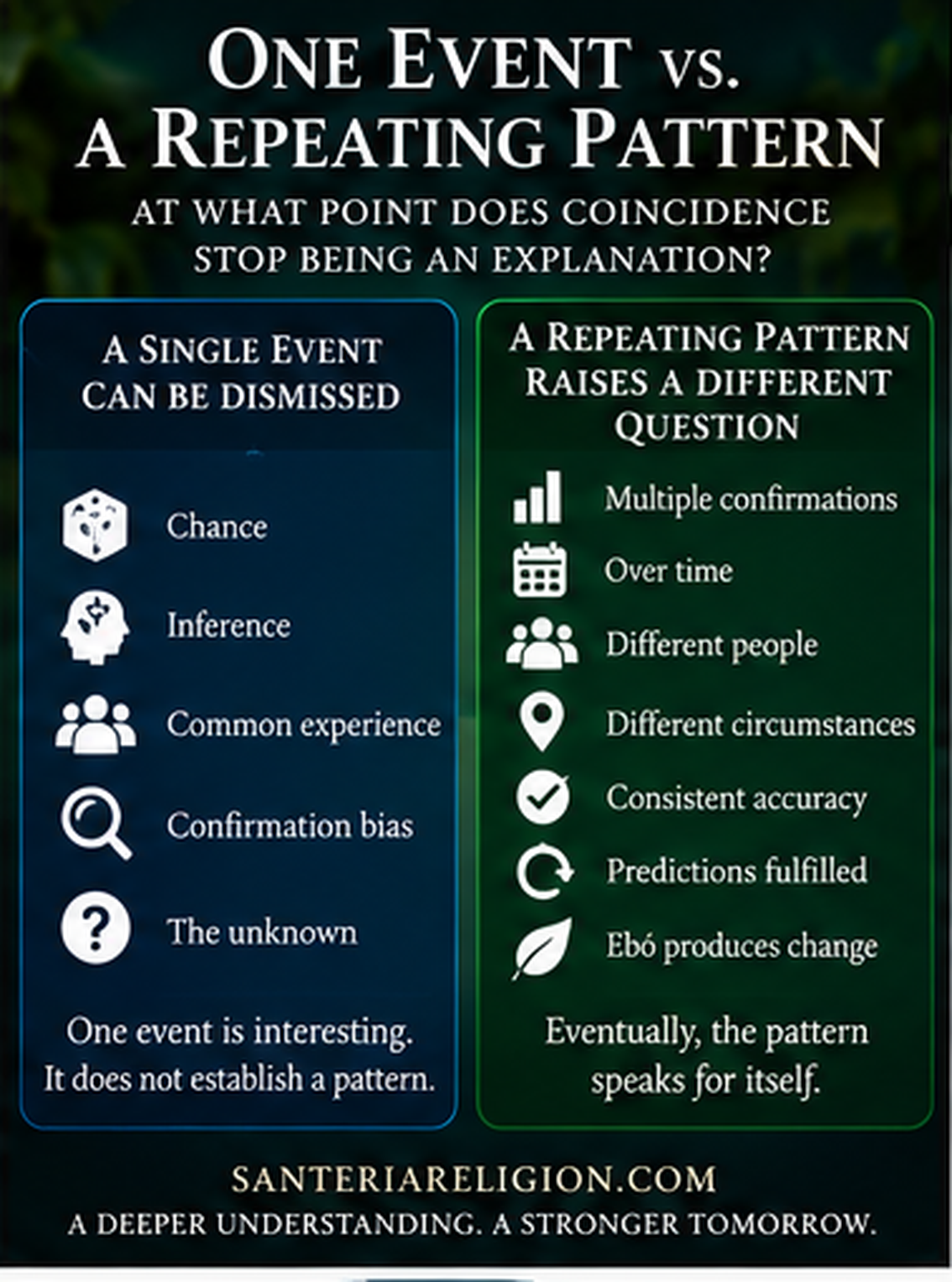
The difficulty begins when similar events repeat across unrelated circumstances.
The practitioner identifies something they were not told.
It is confirmed.
Another consultation happens.
Another unexpected detail is confirmed.
A future event is described.
It happens.
A particular Orisha repeatedly presents before the client discloses a meaningful connection to that Orisha.
A condition is identified.
Ebó is prescribed.
The person later reports that the problem resolved.
Then another person does the same.
At some point, "coincidence" has to explain more and more.
The word itself does not explain anything.
It names the possibility that events occurred together by chance.
The real question is whether chance remains a reasonable account of the pattern.
Specificity Changes the Question
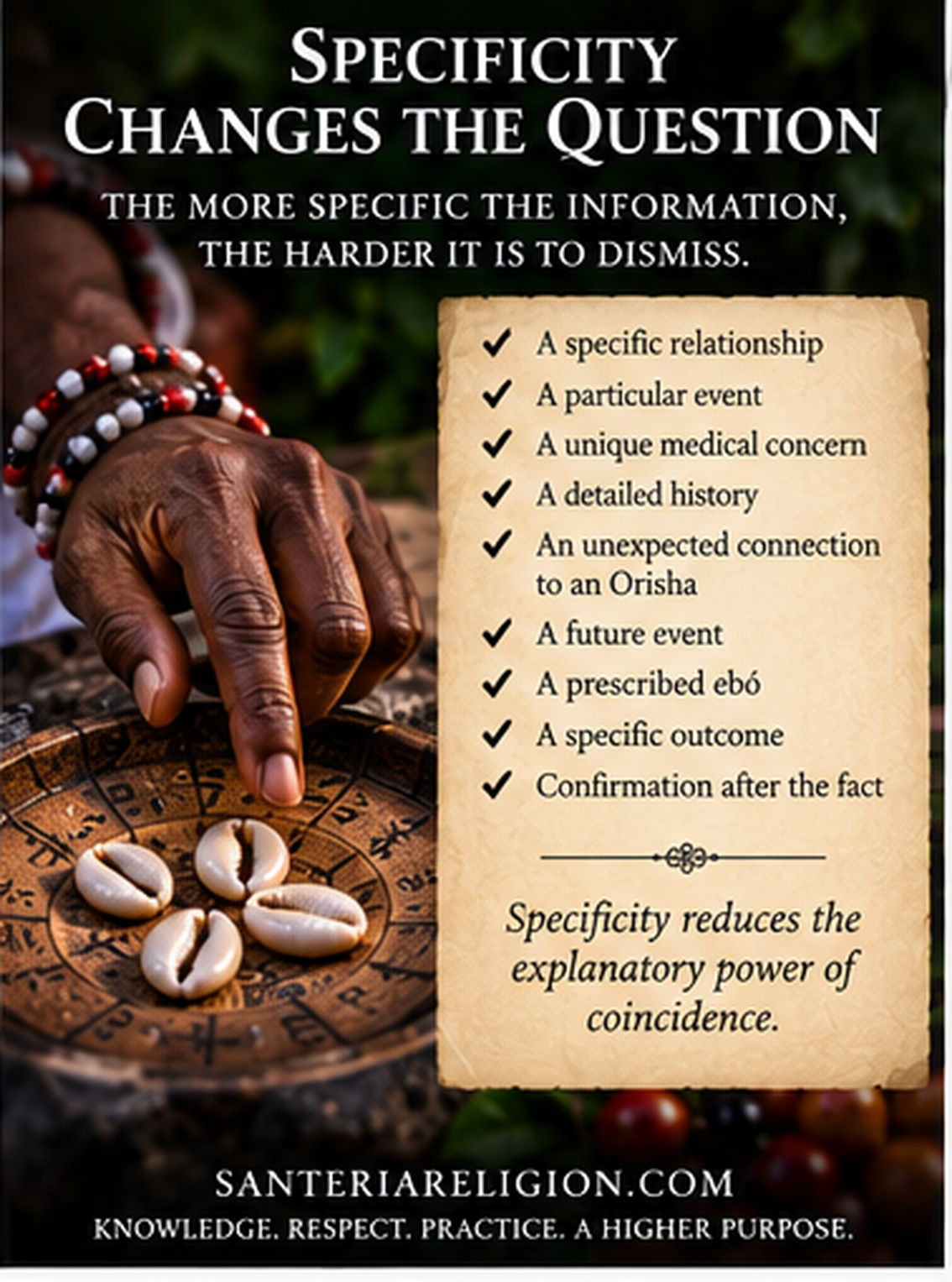
General statements are easy to match.
"You have experienced stress."
"You have had difficulty with someone close to you."
"You are worried about money."
Those statements would describe enormous numbers of people.
Specific information creates a different problem.
The more particular the information, the smaller the number of plausible matches.
A particular relationship.
A particular type of event.
A particular bodily concern.
A specific history.
A prediction tied to a particular domain.
A prescribed intervention followed by the specific change that was marked.
Each layer of specificity reduces the explanatory power of vague coincidence.
This is one reason careful practitioners should preserve exactly what was said.
Memory becomes less important when the record exists before the confirmation.
The Sequence Matters
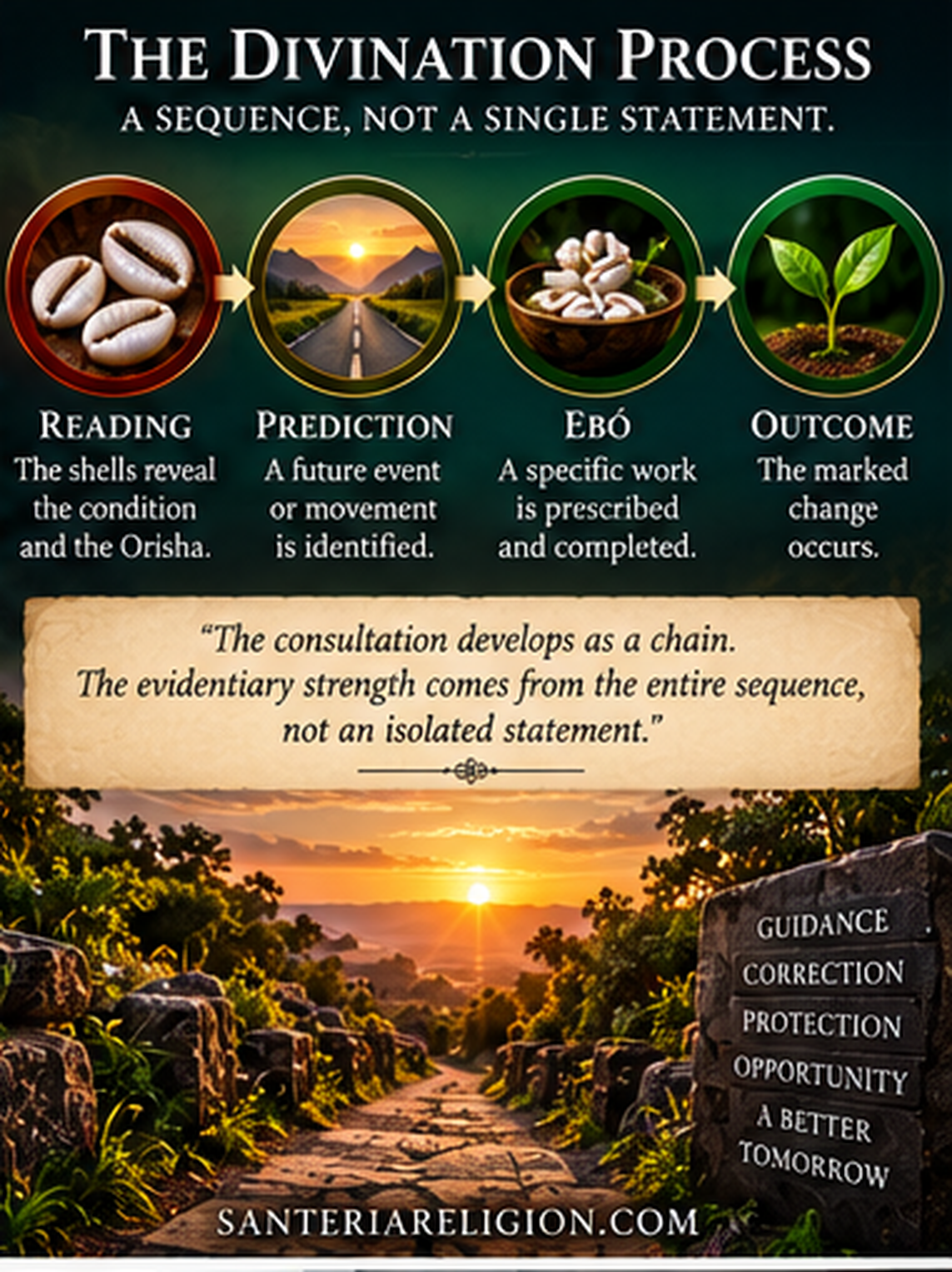
Diloggún should not be evaluated as isolated sentences selected after the fact.
The sequence matters.
An Odú opens.
A condition is established.
The source is narrowed.
An Orisha may step forward.
Questions are asked.
Possibilities are confirmed or rejected.
Ebó may be prescribed.
An outcome may be marked.
The consultation develops as a chain.
The evidentiary strength comes partly from that chain.
If the interpretation were created only after learning what happened, the explanation would be easy.
But when the sequence exists before the client responds, something different is occurring.
The reading has committed itself.
Confirmation Can Come Later
Some confirmations happen during the consultation.
Others arrive after.
A client may hear something and immediately recognize it.
Another may say they do not understand.
Days later, they discover what the reading was referring to.
Sometimes family members provide information.
Sometimes events unfold.
Sometimes a person returns months later and mentions something almost casually that confirms what had been marked before.
These delayed confirmations have always interested me.
The practitioner no longer controls the circumstances.
Time has intervened.
Life has continued.
Then reality meets the reading.
Prediction Raises the Standard
Identifying something that already exists is one level of divination.
Prediction introduces another.
Once a consultation describes what is likely to happen, the reading moves beyond reconstructing the present.
The future has not occurred yet.
The practitioner cannot observe it.
The client cannot confirm it at that moment.
The statement waits.
Time becomes the test.
Some predictions concern broad movement.
Others concern relationships, opportunity, conflict, restoration, closure, or another identifiable domain.
Again, specificity matters.
A vague prediction can fit almost anything.
A meaningful prediction risks being wrong.
That risk is precisely what makes it informative.
Ebó Raises the Question Again
For me, prediction is still not the most important part.
The deepest question begins when divination becomes intervention.
The reading identifies a condition.
A specific ebó is prescribed.
The person performs it.
The condition changes.
This sequence has a different character from simply describing information.
Something happened after an action that was prescribed through divination.
That does not automatically prove why the change happened.
It does make the outcome worth taking seriously.
Especially when the pattern repeats.
The Strongest Cases Have Structure
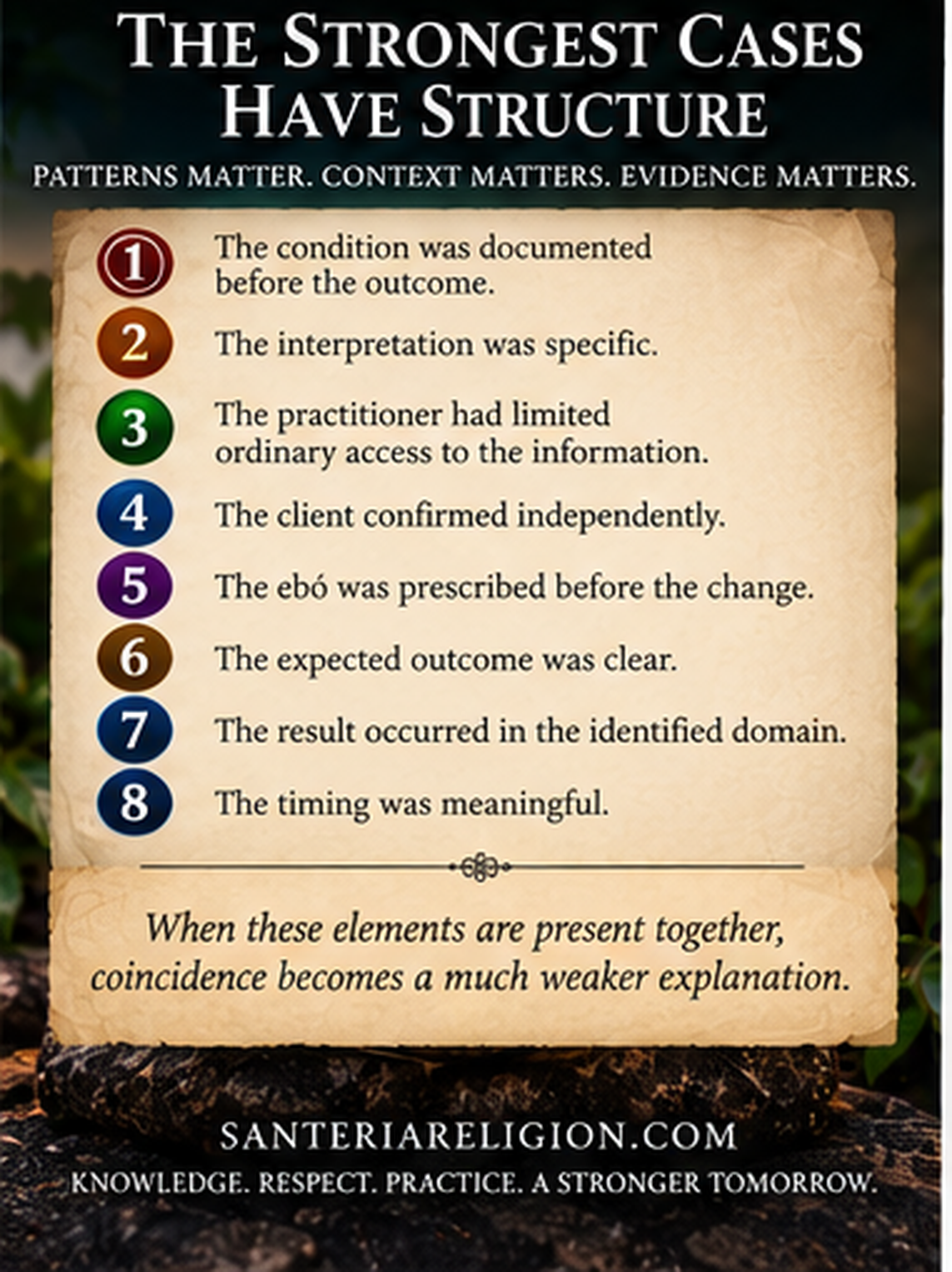
The cases I find most compelling tend to contain several elements at once.
The condition was documented before the outcome.
The interpretation was specific.
The practitioner had limited ordinary access to the information.
The client confirmed something independently.
The ebó was prescribed before the change.
The expected outcome was clear.
The result occurred in the domain that had been identified.
The timing was meaningful.
No single element carries the entire argument.
Together they create structure.
And structured evidence is harder to dismiss than a story remembered years later.
Memory Is Not Enough
Human memory is powerful.
It is also imperfect.
We reconstruct.
We emphasize.
We forget.
We connect events later.
Anyone serious about evidence has to respect that limitation.
That is why I increasingly value contemporaneous records.
Written notes.
Recorded consultations.
The exact sequence of Odú.
Questions asked.
Answers received.
What was confirmed.
What was rejected.
What ebó was prescribed.
What outcome was expected.
Then the later response.
When those records exist, the discussion changes.
We no longer have to depend entirely on someone's memory of what they think happened.
There is a before and an after.
The Misses Matter Too
If someone wanted to examine Diloggún scientifically, they would need to preserve the entire record.
Accurate statements.
Inaccurate statements.
Ambiguous statements.
Predictions that occurred.
Predictions that did not.
Cases with strong follow-up.
Cases where the client disappeared.
Successful outcomes.
Unchanged outcomes.
The goal would be to understand the pattern as it actually exists.
Cherry-picking only spectacular cases would weaken the investigation.
A system that is real should be able to survive honest documentation.
That principle does not threaten my faith.
It respects the seriousness of what I have experienced.
Research Cannot Dictate the Religion
There is also a boundary.
The religious practice cannot be altered merely to satisfy a research design.
If Elegguá prescribes ebó, I would not withhold it from someone so that researchers can create an untreated control group.
That would be unethical in my understanding of the religion.
It would violate the consultation.
It could interfere with someone's life.
Some people come for help during extremely serious circumstances.
The human being cannot become secondary to methodology.
Any legitimate investigation must respect that.
Observation Can Still Be Rigorous
The absence of a conventional experiment does not mean nothing can be studied.
A prospective observational design could document consultations before outcomes occur.
The reading could be time-stamped.
The initial condition could be recorded.
The expected outcome could be specified.
The ebó could be documented without revealing sacred material that should remain private.
Follow-up could occur at a defined interval.
Thirty days would be practical in many cases.
Independent evaluators could assess how closely later outcomes corresponded to what had been recorded.
External records could be used where appropriate and where the participant consents.
The religion would remain untouched.
The observation would become more disciplined.
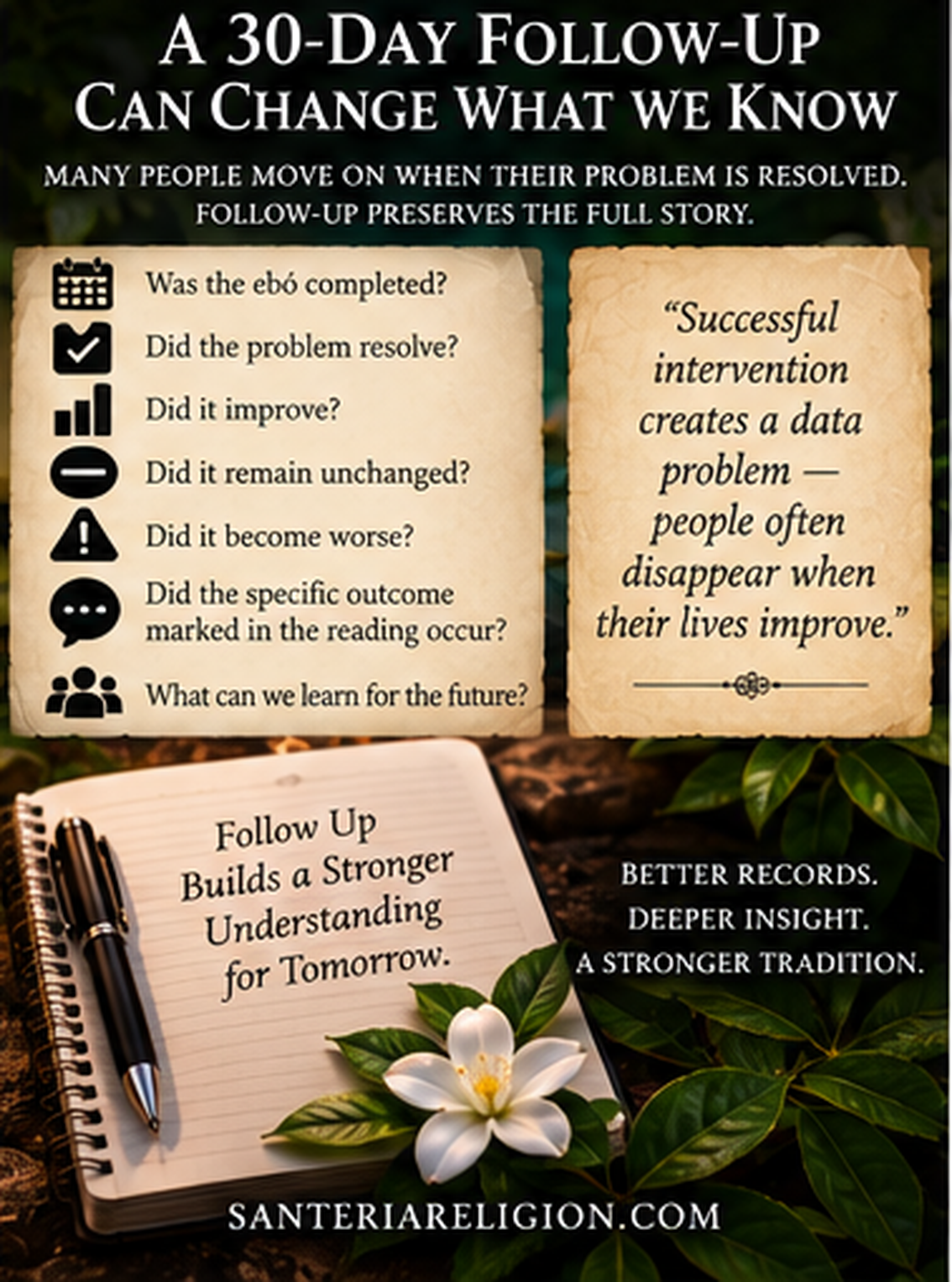
A 30-Day Follow-Up Could Change What We Know
There is a simple problem in spiritual practice.
When people are suffering, they contact you.
When they get better, they frequently move on.
That makes sense.
If your crisis ends, you stop organizing your life around the crisis.
The practitioner may never learn what happened.
A simple 30-day follow-up could preserve information that is currently lost.
Was the ebó completed?
Did the original problem resolve?
Improve?
Remain unchanged?
Become worse?
Did the specific outcome marked in the consultation occur?
That alone could create a valuable longitudinal record.
No religious practice would need to be changed.
We would simply become better at remembering what happened afterward.
Successful Intervention Creates a Data Problem
There is an irony here.
If the work is effective, the person may be less likely to return.
The problem that motivated the relationship has disappeared.
That means successful cases can vanish from observation.
Later, someone may return for an unrelated issue and casually say:
"By the way, everything from the last time worked out."
That information matters.
It also shows why ordinary client records may underestimate outcomes.
Follow-up is not random.
People often communicate most when something is wrong.
Science and Spiritual Experience Ask Different Questions
Science is designed to examine observable patterns.
How often did something happen?
Under what conditions?
Could chance explain it?
Could information leakage explain it?
Could ordinary inference explain it?
Do independent observers agree?
Does the effect replicate?
Those are legitimate questions.
Religious experience asks additional questions.
Who is speaking?
Why did this Orisha stand?
Why was this work prescribed?
What does this relationship mean?
What responsibility does the practitioner carry?
Those questions cannot always be collapsed into the same method.
They do not need to be enemies.
What Evidence Could Establish
Imagine hundreds of prospective consultations documented before client feedback.
The reading is preserved.
Specific claims are identified in advance.
Outcomes are followed.
Independent raters compare recorded readings with later events.
Possible information leakage is controlled.
Base rates are considered.
Negative outcomes remain in the dataset.
The study is repeated across practitioners.
Suppose the results consistently exceeded what chance, ordinary inference, or known information sources could reasonably explain.
That would matter.
It would provide empirical evidence that something extraordinary is occurring during the consultation.
The statistical finding would describe the observable effect.
People could still debate the ultimate metaphysical explanation.
For the practitioner living with Orisha, that debate would exist beside a much larger body of personal experience.
I Already Know What the Experience Means to Me
This distinction is important.
I do not need a research study to decide whether Orisha is real to me.
The relationship came first.
The experiences came first.
Years of confirmations came first.
The research question would serve another purpose.
It would allow other people to examine systematically what practitioners already experience.
That can be valuable.
It is simply a different task.
Fundashe Is Part of the Question
There is another dimension that any serious investigation would eventually confront.
Are all practitioners equally accurate?
I doubt it.
Technique matters.
Experience matters.
Character matters.
Consecration matters.
Relationship matters.
Fundashe matters.
A person can know every published meaning of an Odú and still fail to understand the conversation.
If practitioners differ meaningfully, then studying Diloggún as though every reader were interchangeable could obscure the phenomenon.
That would be similar to evaluating surgery while pretending every person holding a scalpel has equivalent skill.
The practitioner is part of the system being observed.
Character May Affect Capacity
This is where the subject becomes even more difficult for conventional analysis.
In my understanding, Fundashe is earned.
It can grow.
It can be diminished.
It can be lost through abuse.
Orisha knows the person carrying the gift.
That means spiritual capacity cannot necessarily be separated from character.
Humility.
Integrity.
Service.
Restraint.
Loyalty.
The proper use of sacred knowledge.
These qualities may matter to the functioning of the practice itself.
A purely mechanical model could miss that entirely.
Consecration May Matter Too
If consecration changes the practitioner, then another empirical question becomes possible.
Do differences appear between people with different levels of legitimate religious formation?
Do experienced consecrated practitioners perform differently from people relying primarily on textual knowledge?
Do certain kinds of spiritual relationships correspond with different forms of accuracy or perception?
Those would be difficult questions to study well.
They are still questions.
The fact that something is difficult to measure does not make it unworthy of investigation.
The Practitioner Must Remain Humble
Repeated confirmation creates another danger.
Confidence can become ego.
A practitioner begins seeing accurate outcomes and starts believing they are personally extraordinary.
That would misunderstand the source.
The shells are not speaking because the practitioner became a god.
The practitioner listens.
Orisha speaks.
Fundashe is entrusted.
The more astonishing the confirmation, the stronger the reason for gratitude.
No Practitioner Should Claim Perfection
Accuracy does not require pretending to be infallible.
Practitioners can misunderstand.
They can ask a question poorly.
They can interpret something incorrectly.
They can allow assumptions to interfere.
They can move too quickly.
They can mistake intuition for confirmation.
The shells can correct us.
Humility allows that correction.
A serious discussion of evidence has room for human error.
It should.
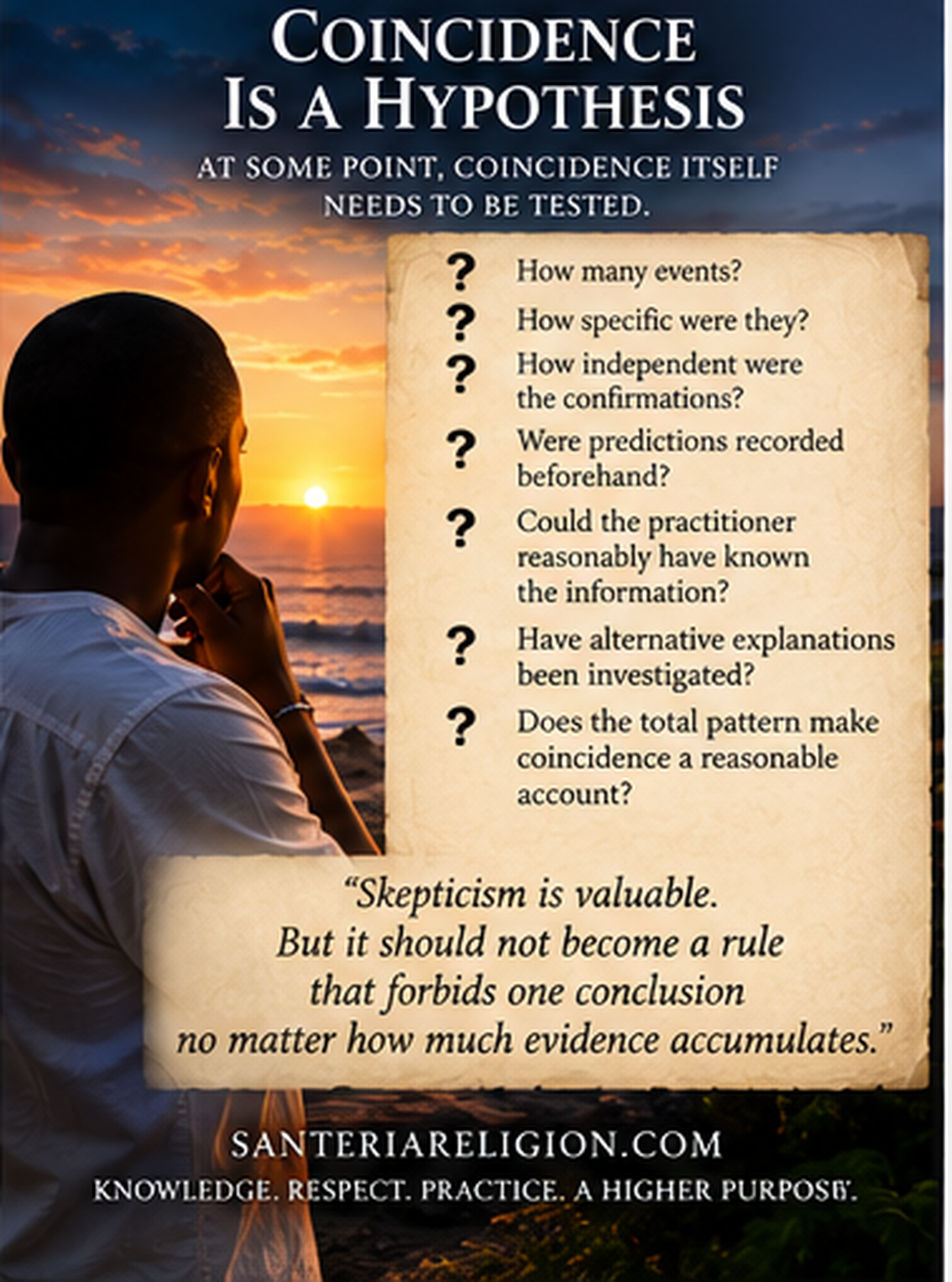
Coincidence Is a Hypothesis
I have come to think of coincidence differently.
Coincidence should not be used as an automatic ending to the conversation.
It is one possible explanation.
Like any explanation, it has to account for what was observed.
How many events?
How specific were they?
How independent were the confirmations?
How often did they occur?
Were predictions recorded beforehand?
Did prescribed interventions produce the marked outcomes?
Could the practitioner reasonably have known the information?
Were alternative explanations investigated?
At some point, coincidence itself becomes the hypothesis that needs testing.
The Cumulative Weight Matters
Human beings often evaluate extraordinary experiences one at a time.
This case could be coincidence.
That case could be inference.
Another could be luck.
Another could be memory.
Another could be suggestion.
Each explanation may sound plausible in isolation.
The problem is the total.
If hundreds or thousands of events accumulate, the explanatory burden changes.
You cannot continually reset the probability to zero after every confirmation.
The history matters.
The accumulation matters.
The pattern matters.
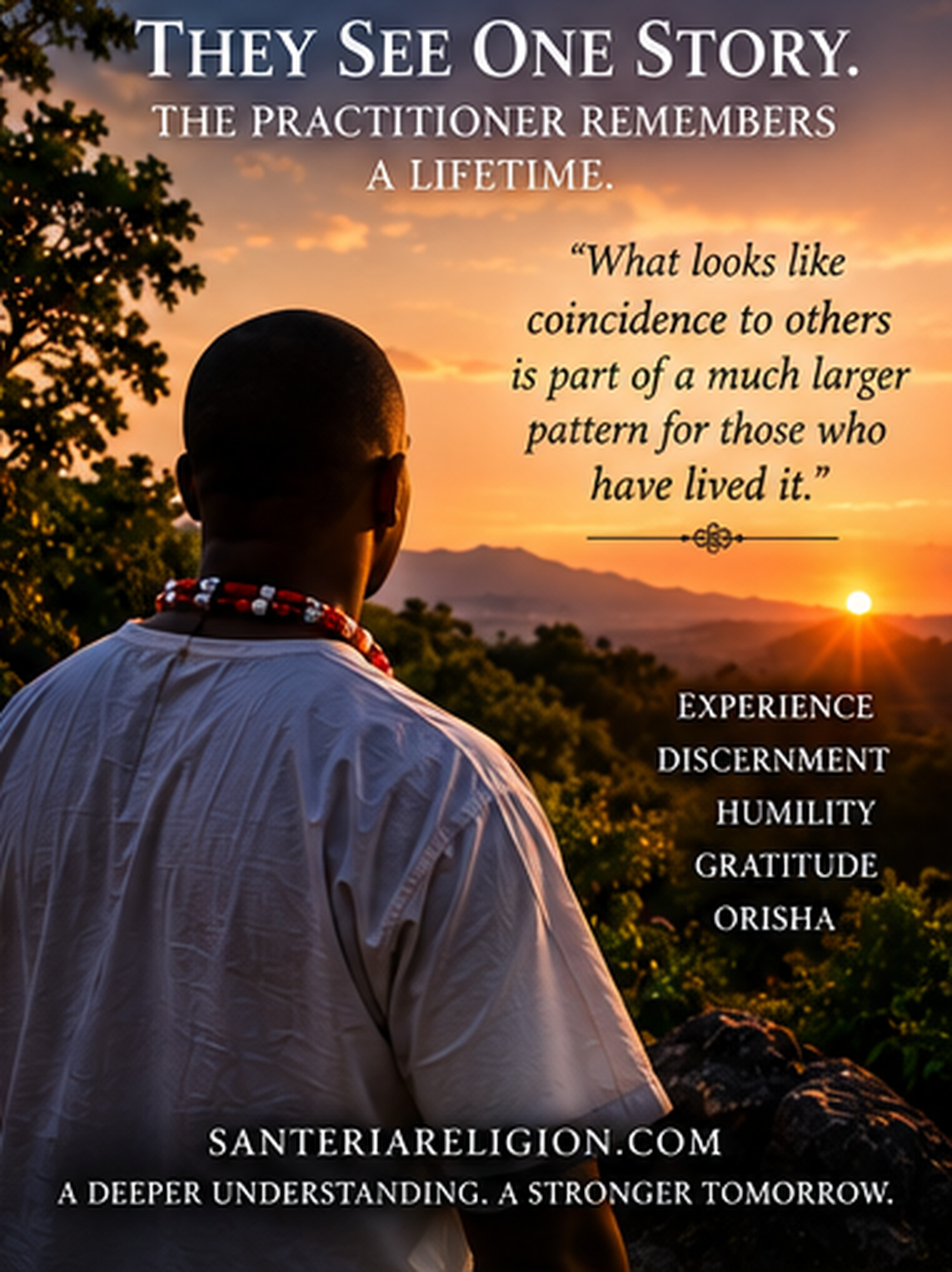
This is the point that people who have not spent years working with divination may have difficulty understanding.
They see one story.
The practitioner remembers a lifetime.
Relationship Becomes Evidence Too
There is another form of evidence that is difficult to quantify.
Relationship.
Over time, you begin recognizing how a particular Orisha communicates.
You recognize patterns.
Corrections.
Warnings.
Ways you are redirected.
Moments when you ignored guidance and later understood why it mattered.
Moments when you followed something you did not fully understand and eventually saw the reason.
This does not replace empirical documentation.
It explains why the practitioner's knowledge of Orisha can become deeply personal.
You know someone partly through repeated interaction.
I experience Orisha through relationship in much the same way.
Experience Changed My Standard of Proof
Before living these experiences, I could imagine dismissing many of them individually.
After years of them, that became increasingly difficult.
Eventually, I realized that refusing to consider Orisha as the explanation would itself require me to ignore an enormous amount of evidence from my own life.
Skepticism is valuable.
It should protect us from believing too easily.
It should not become a rule that says one conclusion is forbidden regardless of how much evidence accumulates.
That is no longer skepticism.
It is predetermined belief.
I Still Ask
Perhaps the most important result of all these confirmations is that I still ask.
I do not assume.
I do not believe every thought entering my mind comes from Orisha.
I do not believe intuition makes confirmation unnecessary.
I ask.
The shells answer.
That discipline protects the relationship.
It also protects me from myself.
The Question Is Larger Than Belief
For people outside the religion, the question may be:
Is Orisha real?
For me, years of lived experience have already answered that question.
A more interesting question now is:
What happens when we document the phenomenon carefully enough that other people can examine it?
Perhaps the results would surprise people.
Perhaps they would identify things practitioners themselves had not noticed.
Perhaps they would show differences among practitioners.
Perhaps they would reveal where intuition helps and where it misleads.
Perhaps they would show that certain forms of prediction or intervention are stronger than others.
Real inquiry should be willing to learn.
Orisha Does Not Need Scientific Permission to Exist
Science is one of humanity's most powerful ways of studying the observable world.
I respect it deeply.
I also understand its boundaries.
A statistical model does not grant existence to something that was already there.
Research can document.
Measure.
Compare.
Test alternatives.
Estimate probability.
It can help human beings see patterns more clearly.
Orisha does not become real when a journal accepts a paper.
For those of us living with them, the relationship precedes publication.
What Research Could Give Us
Still, I believe there could be tremendous value in careful documentation.
It could preserve practitioner knowledge.
It could distinguish strong claims from weak ones.
It could help us understand patterns in consultation outcomes.
It could create a record for future generations.
It could show how much information disappears because successful clients never follow up.
It could reveal whether certain reading structures predict particular outcomes.
It could allow serious scholars to engage a living religious system without reducing it to folklore or outsider description.
Most importantly, it could document the religion from within the experience of people who actually practice it.
When the Pattern Becomes the Evidence
I do not believe because one remarkable event happened.
I believe because the events kept happening.
Across years.
Across people.
Across circumstances.
Across questions I could not have anticipated.
Across information I did not know.
Across outcomes that had not happened yet.
Across ebó that produced the movement Elegguá said it would produce.
Eventually the accumulation itself became evidence.
Could every individual event have another explanation?
Perhaps.
But an explanation for one event is not automatically an explanation for thousands.
At some point, the entire pattern has to be confronted.
For me, the simplest answer became the one sitting in front of me all along.
The shells fall.
The conversation begins.
The information arrives.
The road is revealed.
The work is prescribed.
Life responds.
And Orisha continues to confirm that we are not alone at the mat.
Maferefun Elegguá. Maferefun Orisha.
About the Author
Keith Lawrence Miller, M.A. (Ogun Oní) is the founder of SanteriaReligion.com, an independent educational platform devoted to Santería, Regla de Ocha, Lucumí religious literacy, Diloggún, Orisha tradition, religious history, spiritual development, and the preservation of sacred boundaries.
His work draws upon lived religious experience, sustained study, practitioner knowledge, public theology, research training, and respect for the authority of elders, godparents, lineages, and individual houses.