
Santería emerged through human beings who preserved sacred relationships under slavery and colonial rule, then continued to teach, debate, adapt, and build community across generations.
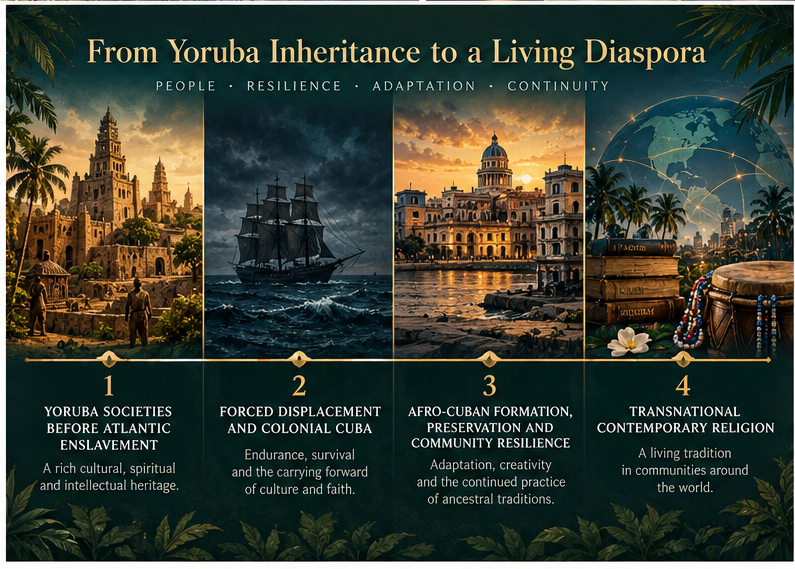
Before Atlantic enslavement
Yoruba-speaking societies in West Africa sustained diverse political, artistic, philosophical, and religious institutions. Orisha devotion was never a single frozen system; communities and towns carried distinct relationships and histories.
Atlantic slavery and forced displacement
Enslaved people carried language, memory, ritual intelligence, names, rhythms, stories, and religious relationships across the Atlantic under conditions designed to sever community and identity.
Colonial Cuba
People identified as Lucumí rebuilt community through kinship, mutual-aid societies, cabildos, religious houses, music, and adaptive forms of devotion. Catholic imagery sometimes provided public cover, but the tradition cannot be explained as a simple mixture of equivalent saints and Orisha.
Formation of Regla de Ocha
Houses, elders, lineages, and ritual systems developed in Cuba through preservation, innovation, debate, and transmission. Variation reflects real histories rather than an absence of structure.
Migration and transnational growth
Cuban migration helped establish communities across the United States, Latin America, Europe, and elsewhere. New settings brought legal struggles, public misconceptions, commercialization, and expanded dialogue with Nigeria and other diasporic traditions.
A living present
Santería today is practiced in homes, houses, communities, and transnational networks. It remains a religion of relationship, responsibility, ancestors, Orisha, divination, ceremony, music, and ongoing interpretation.
Evidence and interpretation
Sources and claim basis
This public timeline synthesizes scholarship on Yoruba history, Afro-Cuban religious formation, migration, and living transnational practice. It is an orientation rather than a lineage history or a claim that every house developed identically.
- Documented history and scholarship
- Historical statements are grounded in the public sources listed below and remain open to correction as scholarship develops.
- Practitioner tradition
- Religious meaning is described as practitioner understanding rather than laboratory proof or a universal rule.
- Lineage and house variation
- Public descriptions do not erase meaningful differences among houses, regions, elders, and related Yoruba or diasporic traditions.
Public sources
- Akinwumi Ogundiran. The Yoruba: A New History. Indiana University Press, 2020.Scholarly book
A transdisciplinary history of Yoruba people, institutions, cultural formation, and long-term change.
- George Brandon. Santeria from Africa to the New World: The Dead Sell Memories. Indiana University Press, 1993.Scholarly book
A historical account of Yoruba religious traditions moving through Cuba and into New York, with attention to memory and change.
- David H. Brown. Santería Enthroned: Art, Ritual, and Innovation in an Afro-Cuban Religion. University of Chicago Press, 2003.Scholarly book
Ethnohistory, material culture, institutional development, ritual innovation, and continuity in Afro-Cuban Lucumí religion.
- Aisha M. Beliso-De Jesús. Electric Santería: Racial and Sexual Assemblages of Transnational Religion. Columbia University Press, 2015.Scholarly book
Ethnography of transnational Santería across Cuba and the United States, including race, gender, movement, media, and copresence.
- Smithsonian Latino Center. A History of Santería public program, 2010.Public institution
A public program bringing together practitioner testimony, historical analysis, and performance to discuss Afro-Cuban religious history.