
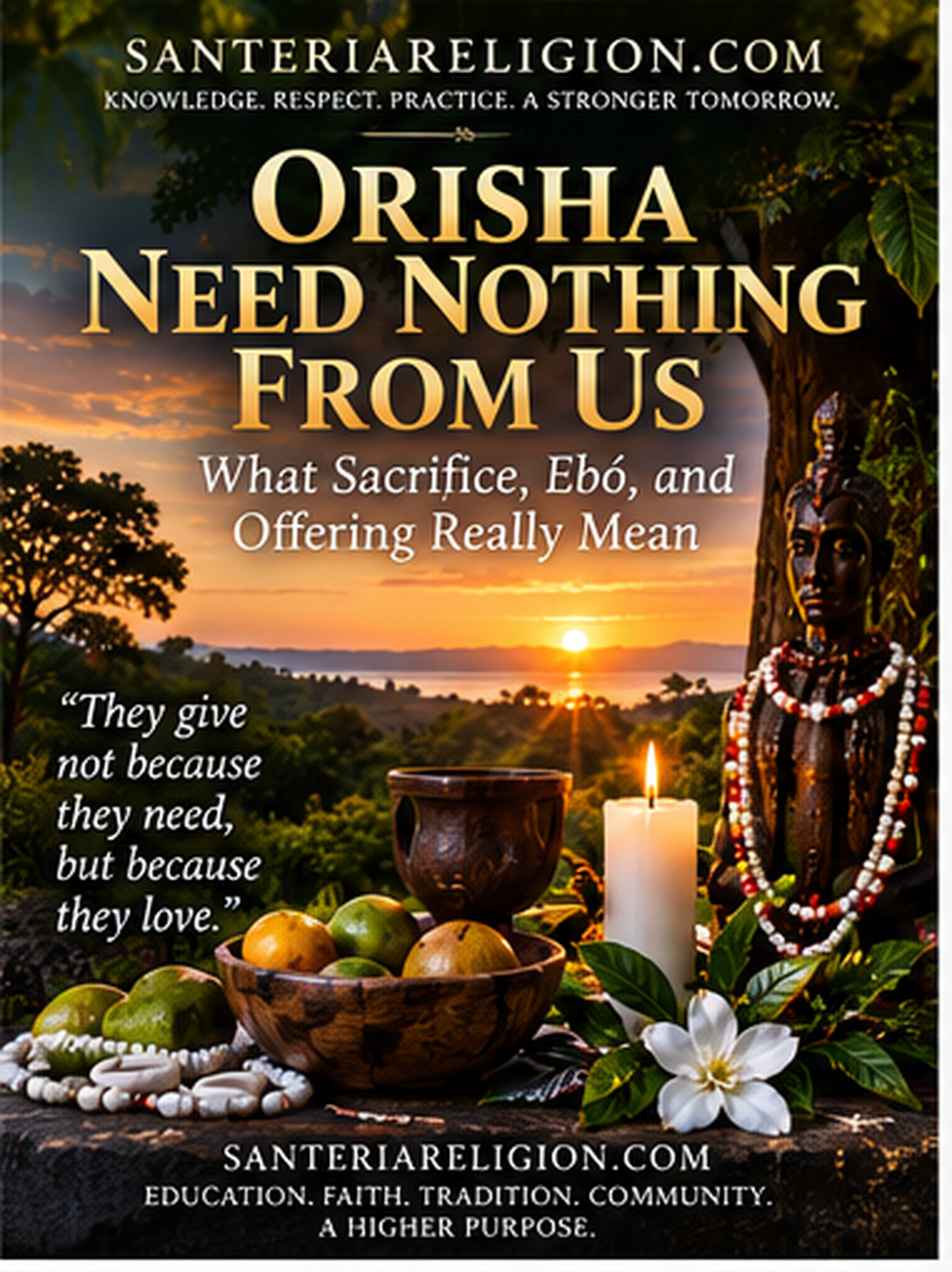
Orisha does not need fruit, candles, money, or anything else human beings can provide. Keith Lawrence Miller explores ebó as intervention, sacrifice as transformation, and why love may be the deepest offering we can give.
One of the easiest ways to misunderstand Santería is to look at an offering and assume that the Orisha needs what is being given.
A person sees fruit.
Candles.
Water.
Rum.
Food.
Coins.
Flowers.
Other materials used in religious work.
From the outside, the conclusion can seem obvious: these things are being given because the Orisha wants or needs them.
That is not how I understand what is happening.
Orisha needs nothing from us.
They are not waiting for human beings to provide something they lack.
They are not hungry because we failed to bring food.
They are not poor because we failed to bring money.
They are not powerless until we light a candle.
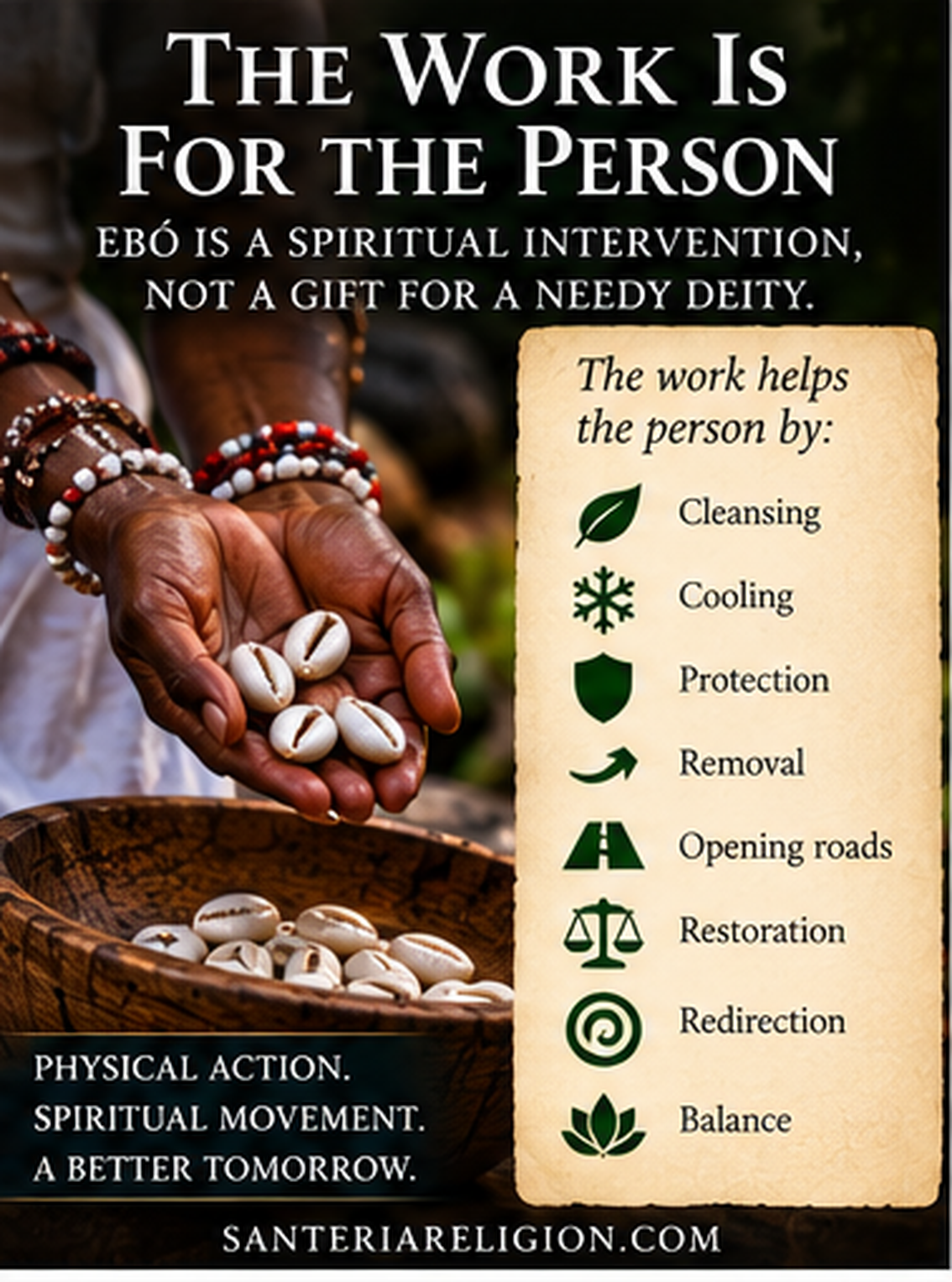
The material things used in ebó serve a purpose, but the purpose centers on the human being and the spiritual condition being addressed.
The work is for us.
The Offering Is Part of the Intervention
This becomes clearer when ebó is understood within the larger structure of divination.
A person comes with a problem.
Diloggún identifies the condition.
The source may be established.
An Orisha may step forward.
A particular work may be prescribed.
Then the person acts.
The physical materials become part of that action.
They may be used for cleansing.
Cooling.
Removal.
Redirection.
Restoration.
Protection.
Opening.
Closing.
Balancing.
Transfer.
The meaning comes from the consultation.
This is why I do not understand ebó as simply giving the Orisha a gift in exchange for a favor.
The material action belongs inside a spiritual process.
Orisha Cannot Be Bribed

Human beings understand transactions very well.
I give you something.
You give me something.
I pay a price.
You provide a service.
That logic dominates much of modern life.
It can easily be projected onto religion.
Someone may begin thinking:
I gave this offering, so now Orisha owes me.
I completed this work, so I should receive exactly what I requested.
I sacrificed something valuable, so the outcome should match my desire.
That reduces Orisha to a transaction.
I do not believe the relationship works that way.
Orisha cannot be bribed.
An offering does not purchase divine obedience.
An ebó does not create a debt that the Orisha must repay according to our terms.
The important question remains:
What did Elegguá actually say the work would accomplish?
The Ebó Produces What Was Marked
This distinction is essential.
Someone may come asking about money.
The consultation may identify something deeper.
Ebó may be prescribed for the underlying condition.
The person may perform the work and then decide it failed because a particular financial result did not immediately appear.
That judgment may have nothing to do with what the reading actually established.
The practitioner must preserve the sequence.
What condition was identified?
What was its source?
Which Orisha took responsibility?
What was prescribed?
What result was marked?
If Elegguá says the ebó will remove a condition, then removal is the measure.
If the reading marks cooling, the work is about cooling.
If restoration is marked, restoration becomes the expected road.
If protection is marked, protection may be the outcome even when the person hoped for something more dramatic.
The work should be understood according to the communication that produced it.
Physical Things Can Carry Spiritual Meaning
Someone may reasonably ask why physical materials are needed at all if Orisha does not need them.
Because human beings live in a physical world.
We act through bodies.
Objects.
Places.
Movement.
Time.
Touch.
Sound.
Food.
Water.
Earth.
Fire.
The material and spiritual dimensions of religious life are not necessarily separate.
A physical action can embody release.
An object can become part of cleansing.
A location can matter because of the Orisha or spiritual domain involved.
A number can matter.
A sequence can matter.
An action may represent and participate in the movement being requested.
The material does not need to be understood as food for a hungry deity.
It can function as part of the mechanism of the work.
Ritual Location Can Matter
This is one reason seemingly small details should not be casually changed.
Modern thinking often asks whether an instruction can be made more convenient.
Can the location be changed?
Can something be substituted?
Can the sequence be shortened?
Can another item be used?
Sometimes there may be acceptable alternatives.
Those alternatives should not be invented casually.
If a location has spiritual meaning, moving the work somewhere easier may change the work.
If the destination is part of what receives, contains, carries, cools, removes, or redirects something, then destination is part of the prescription.
The practitioner needs enough understanding to recognize when a detail is logistical and when it is spiritually functional.
That distinction is part of Fundashe.
Sacrifice Changes the Person Giving It
The word sacrifice can create strong reactions.
People often focus on what is surrendered.
I think there is another dimension that deserves more attention.
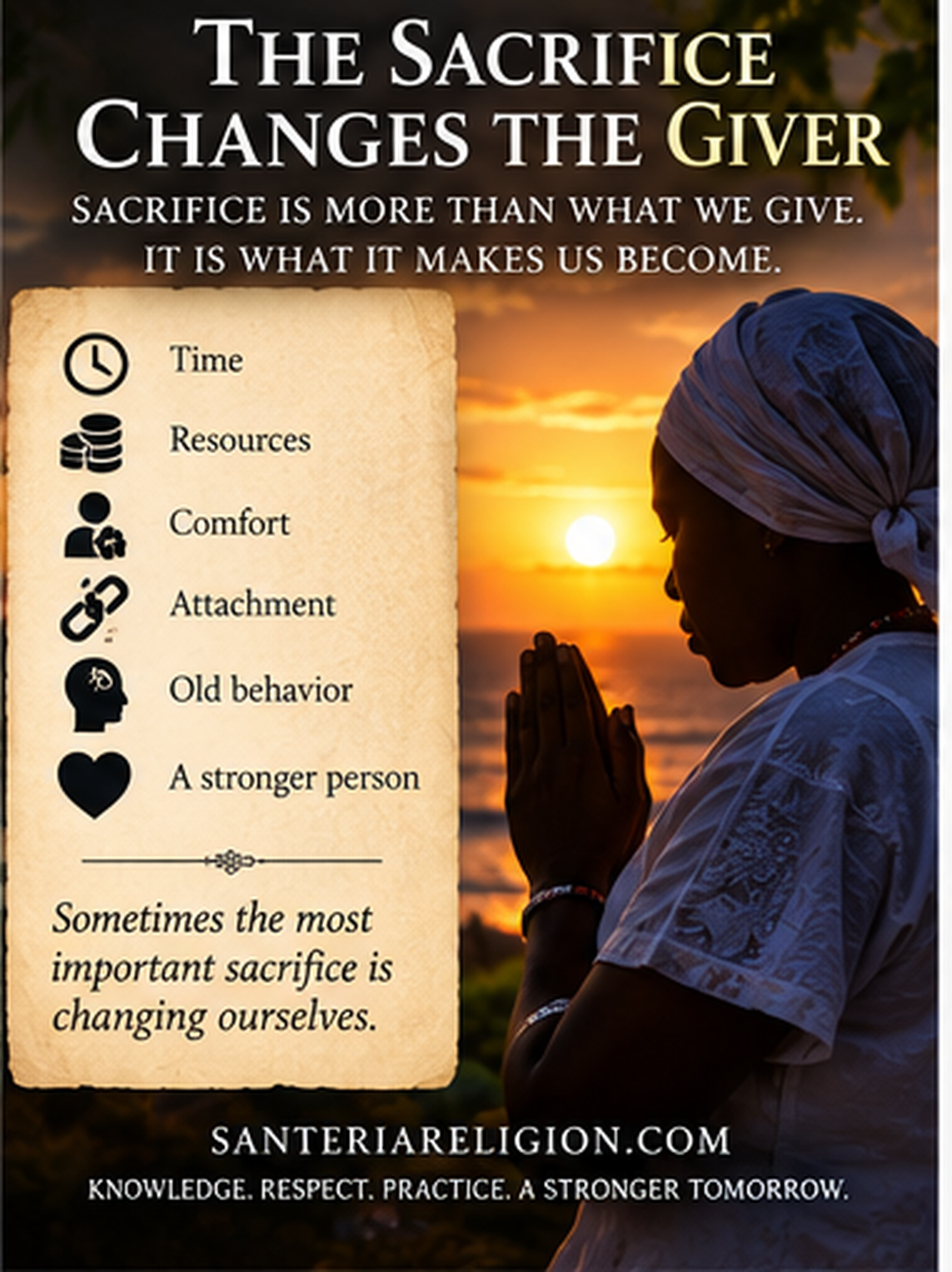
Sacrifice changes the person who gives.
To sacrifice means that something costs you.
Time.
Effort.
Money.
Comfort.
Pride.
Attachment.
Habit.
Certainty.
Convenience.
Sometimes the most meaningful sacrifice is behavioral.
Stop doing what is damaging your life.
Give up the relationship that keeps destroying you.
Fulfill an obligation you have avoided.
Apologize.
Wait.
Control your anger.
Become disciplined.
Release something you desperately want to keep.
The offering may involve material things.
The transformation may be happening inside the person.
Obedience Has Spiritual Meaning
There are times when the value of ebó exists partly in following the instruction.
Human beings like control.
We want to understand every step before acting.
We want the right to negotiate.
We want alternatives.
We want the procedure adapted around our preferences.
Religious obedience asks something different.
If Elegguá identifies a road and the work is confirmed, then following the road becomes part of the spiritual relationship.
That does not mean abandoning judgment.
It does not mean blindly following anyone who claims religious authority.
The practitioner must be trustworthy, the consultation must be genuine, and what is prescribed must actually be established.
Once those conditions exist, obedience itself can become meaningful.
It demonstrates that the person is willing to participate in their own correction.
Ebó Requires Participation
This matters because people sometimes want spiritual work to happen entirely outside themselves.
Fix my problem.
Remove my enemy.
Open my road.
Restore my money.
Bring my relationship back.
The person wants the world changed while remaining exactly the same.
Sometimes the reading will not allow that.
The ebó may require participation.
Action.
Change.
Discipline.
Release.
Humility.
The spiritual intervention and the person's behavior may need to move together.
A person cannot continually recreate the same destructive conditions and then expect religious work to erase every consequence.
Sometimes the road changes because the person changes.
Energy Has to Move
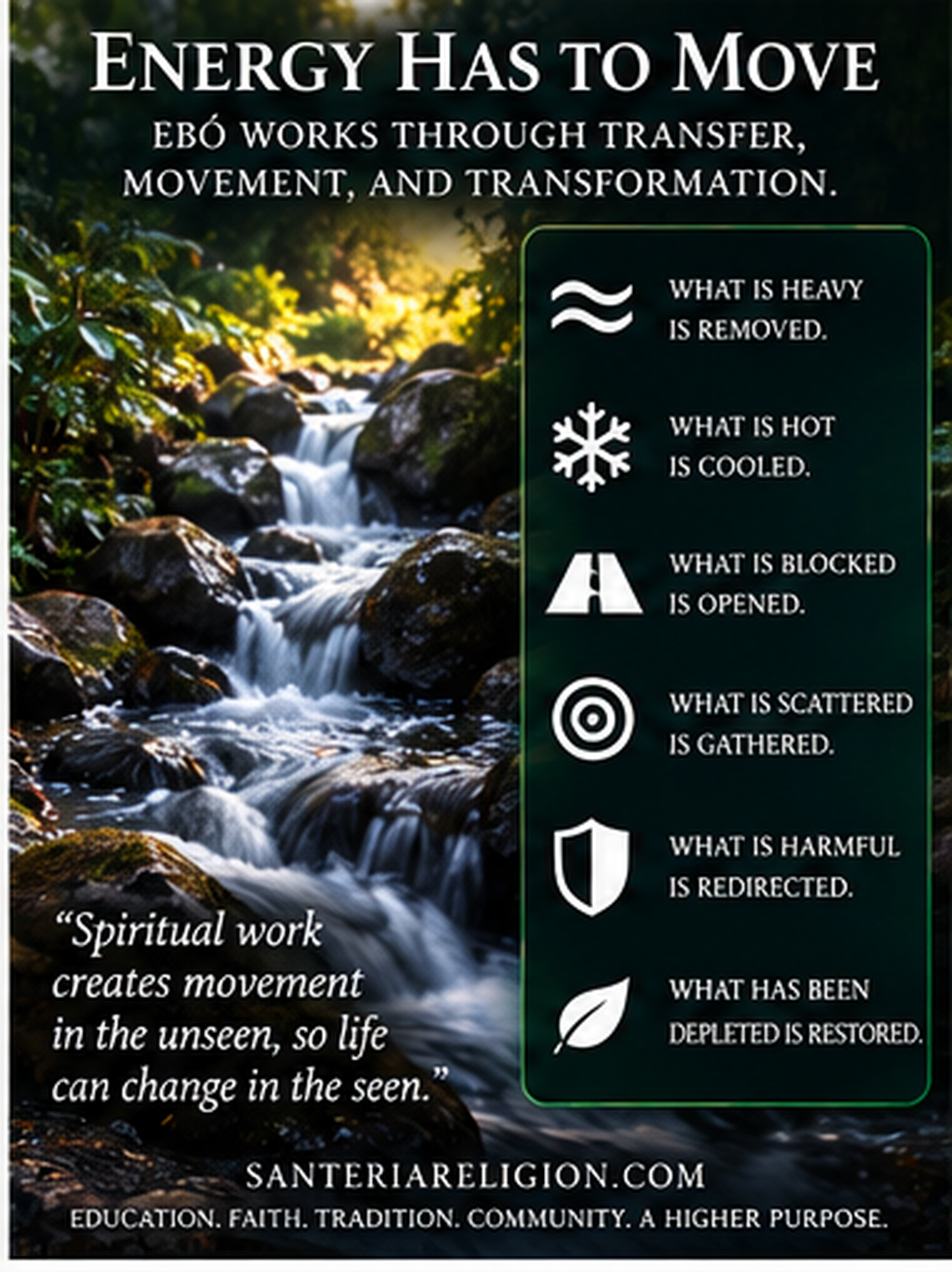
One way I understand ebó is through transfer and movement.
A condition exists.
The person is carrying something.
Something around them is out of balance.
The work moves that condition.
What is heavy may be removed.
What is hot may be cooled.
What is blocked may be opened.
What is scattered may be gathered.
What is harmful may be redirected.
What has been depleted may be restored.
The materials participate in that movement.
From this perspective, the offering is not simply something handed to an Orisha.
It becomes part of the transformation.
Why Specificity Matters
If ebó were merely symbolic gift-giving, almost anything should work.
That has not been my experience.
Specificity matters.
The consultation may identify a particular Orisha.
A particular number.
A particular place.
A particular action.
A particular sequence.
A particular class of material.
Those details create structure.
The practitioner should not become more creative than the reading.
Our responsibility is to follow what has been established.
That is another reason religious knowledge cannot be reduced to memorized recipes.
Two works may contain similar materials and still serve completely different purposes because they emerged from different consultations.
Context changes meaning.
The Practitioner Does Not Own the Power
There is a temptation in spiritual work for the practitioner to become the center of the story.
I did this.
I fixed that.
My work caused this.
That language can slowly distort the relationship.
The practitioner did not invent the road.
We listened.
We interpreted.
We performed or guided what was required.
If the work produces what Elegguá said it would produce, gratitude belongs first to Orisha.
The greater the outcome, the greater the reason for humility.
Fundashe should reduce ego.
Love May Be the Greatest Offering

If Orisha needs nothing material from human beings, what can we genuinely give them?
I believe love may be one of the deepest answers.
Love.
Loyalty.
Gratitude.
Devotion.
Respect.
Remembrance.
Service.
These are not commodities.
They cannot be measured easily.
They cannot be purchased.
They have meaning because they are freely given.
Someone who has been lifted out of a terrible period of life understands gratitude differently.
Someone who felt abandoned and then found a road understands devotion differently.
Someone who has lived with Orisha for years understands relationship differently.
I believe Orisha receives that love.
And I sometimes wonder what greater reward any being could receive than genuine love freely offered.
Love Is Different From Payment
Payment completes a transaction.
Love deepens a relationship.
That distinction matters.
If I give because I expect repayment, the exchange remains centered on me.
If I give because I am grateful, the meaning changes.
Religious devotion becomes impoverished when every action is reduced to:
What will I get for this?
There are things we do because we love Orisha.
Because we remember.
Because we are thankful.
Because they stood with us.
Because they corrected us.
Because they saved us from roads we did not understand.
Because they gave us another opportunity.
Gratitude becomes part of religious life.
Pure Intention Matters
This returns us to Fundashe and character.
Orisha sees the intention behind the act.
Two people can perform the same visible action with very different hearts.
One approaches with gratitude.
Another approaches with entitlement.
One comes humbly.
Another comes trying to control.
One gives because they love.
Another performs because they want to impress others.
Human beings may see the same ritual.
Orisha sees the difference.
Nothing is hidden.
The Most Valuable Offering May Not Be Material
Sometimes what Orisha asks from a person may be more difficult than giving money or food.
Change your behavior.
Stop lying.
Stop hurting someone.
Leave what is destroying you.
Be patient.
Honor your word.
Control yourself.
Take responsibility.
Serve.
Forgive.
Accept correction.
These sacrifices can be much harder than purchasing an object.
They require transformation.
That may be why they are so powerful.
Sacred Work Should Never Become Salesmanship
This theology creates an ethical responsibility for practitioners.
If Orisha needs nothing from us, then the practitioner should never manipulate people into believing that endless material offerings are required simply to generate income.
Fear creates vulnerable clients.
A frightened person can be convinced that another ceremony, another payment, another object, or another urgent work is always necessary.
That is dangerous.
Ebó should come from the reading.
The work should have a reason.
The practitioner should be able to explain the purpose without exploiting fear.
Sometimes integrity means telling someone:
Nothing more is required.
More Is Not Always Better
Human beings often assume that bigger means stronger.
A larger offering.
A more expensive ceremony.
More materials.
More dramatic action.
That assumption can misunderstand spiritual precision.
The right work matters more than the largest work.
If a simple action is marked, complexity does not necessarily improve it.
The practitioner should resist adding unnecessary elements simply to make the work appear impressive.
Elegguá does not require theater.
The Sacred Is Not a Marketplace
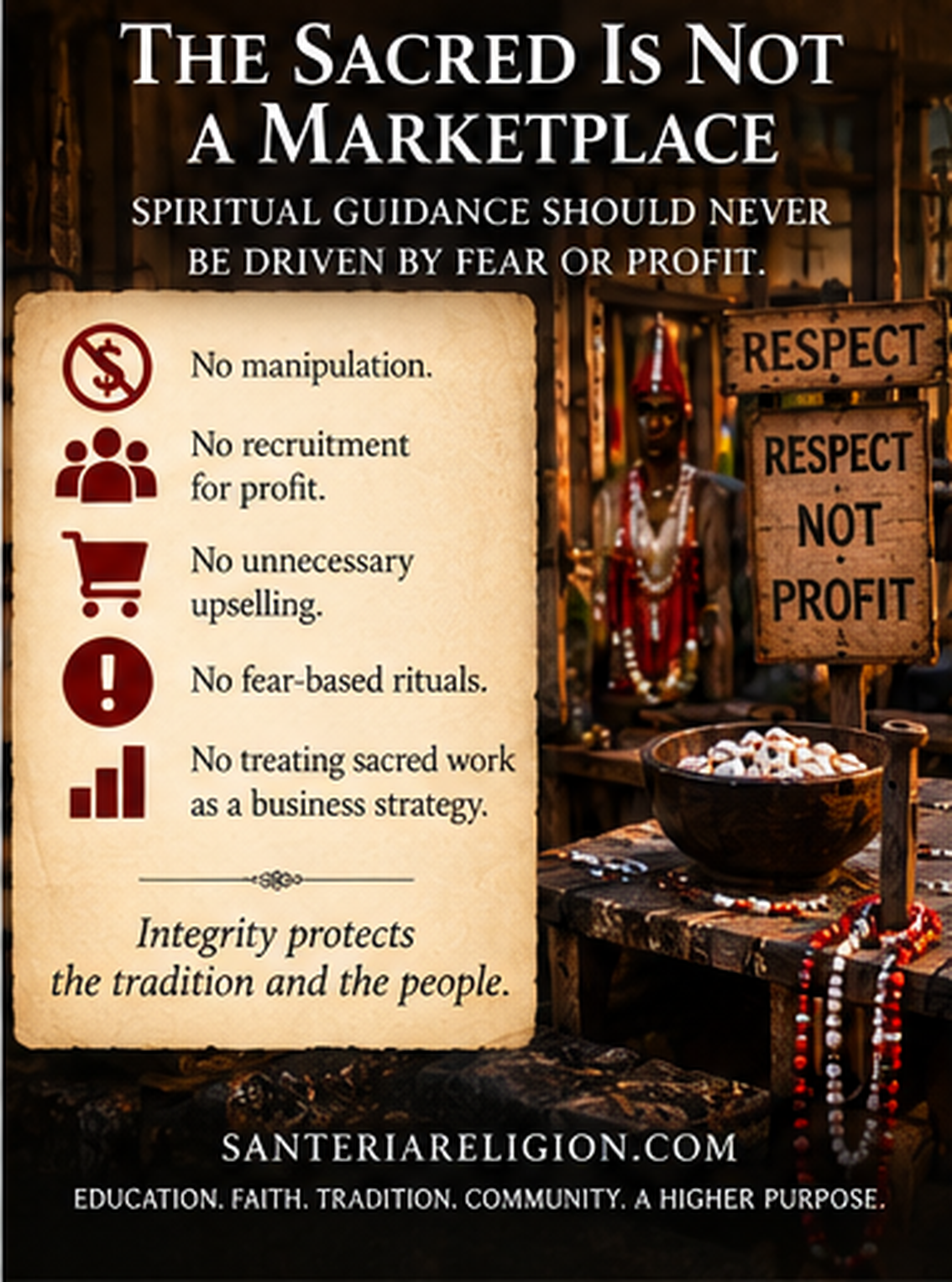
There is nothing inherently wrong with practitioners being compensated for their time, knowledge, labor, materials, or services.
People must live.
Ceremonies require resources.
Communities have real costs.
The problem begins when commerce starts controlling religious interpretation.
The answer changes because there is money attached.
Fear becomes a sales technique.
Initiation becomes recruitment.
Ebó becomes an upsell.
Sacred authority becomes a business strategy.
That is where the practitioner must remember who the work belongs to.
Orisha.
The Person Is the Beneficiary
This may be the simplest way to summarize my understanding of ebó.
Orisha does not need the work.
The person does.
The person needs cleansing.
The person needs correction.
The person needs protection.
The person needs release.
The person needs restoration.
The person needs a road.
The person needs to participate in changing their circumstances.
Ebó gives that person something to do within a spiritual relationship.
That is why I understand it as intervention.
Results Create Responsibility
When a person sees the work produce the outcome Elegguá identified, something changes.
Faith deepens.
Gratitude deepens.
Responsibility deepens.
You begin to understand that the relationship deserves protection.
You begin to take instructions more seriously.
You begin to understand why sacred knowledge cannot be handled casually.
You begin to understand why Fundashe must be protected.
Repeated experience creates reverence.
Orisha Gives Without Needing
There is something beautiful in the idea that Orisha lacks nothing and still gives.
Guidance.
Protection.
Correction.
Strength.
Roads.
Healing.
Transformation.
Opportunity.
Understanding.
They give because that is part of the relationship.
Human beings often understand generosity through exchange.
Orisha teaches another possibility.
To give from abundance rather than need.
What We Can Give Back
We cannot make Orisha greater.
We cannot enrich them.
We cannot provide something they lacked before meeting us.
We can honor them.
We can remember them.
We can protect the traditions entrusted to us.
We can live with character.
We can serve other people.
We can keep our obligations.
We can use what we have been given responsibly.
And we can love them.
Perhaps that is the deepest offering.
Ebó Is for Transformation
A person may begin by seeing fruit, candles, water, food, or other materials.
The deeper question is what the work is doing.
What is being moved?
What is being surrendered?
What is being restored?
What is being corrected?
What is the person being asked to become?
When we understand that, sacrifice begins to look very different.
Orisha does not need our possessions.
The work is for us.
The materials participate in the work.
The sacrifice changes the giver.
The ebó changes the road.
And what remains after the work is completed may be something far more valuable than anything that was placed before Orisha.
Gratitude.
Transformation.
And love.
Maferefun Orisha.
About the Author
Keith Lawrence Miller, M.A. (Ogun Oní) is the founder of SanteriaReligion.com, an independent educational platform devoted to Santería, Regla de Ocha, Lucumí religious literacy, Diloggún, Orisha tradition, religious history, spiritual development, and the preservation of sacred boundaries.
His work draws upon lived religious experience, sustained study, practitioner knowledge, public theology, and respect for the authority of elders, godparents, lineages, and individual houses.