
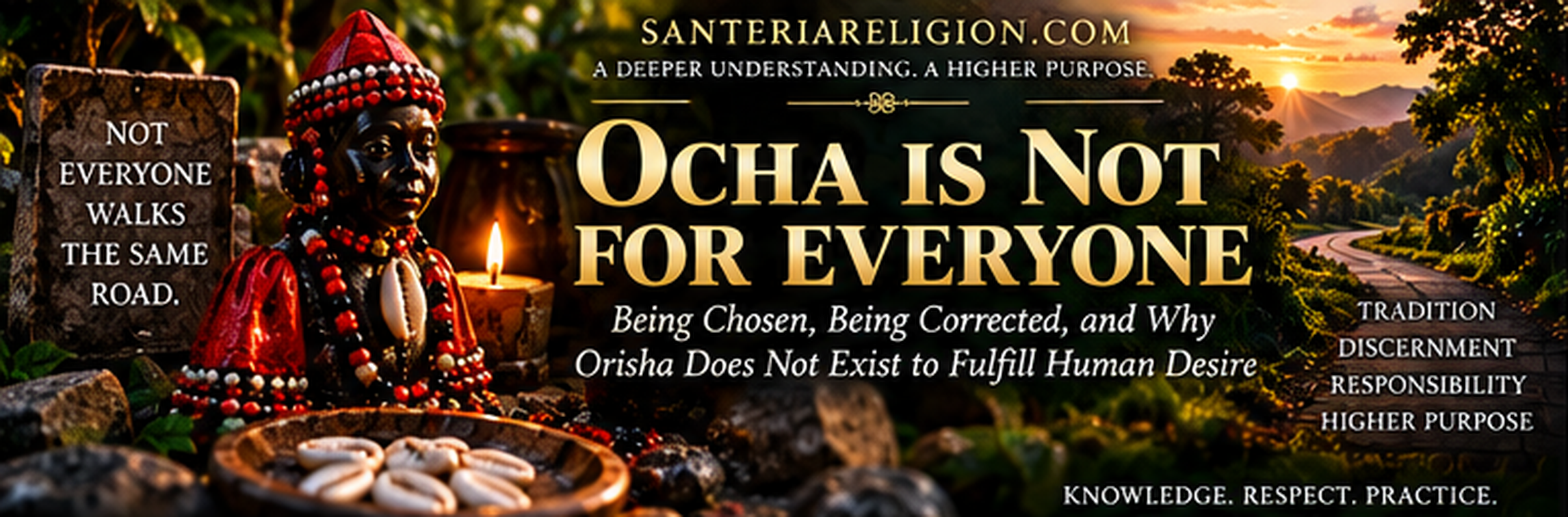
Wanting Ocha and being called to Ocha are different things. Keith Lawrence Miller explores calling, correction, accountability, spiritual responsibility, and why guidance from Orisha cannot be reduced to human preference.
People sometimes approach Ocha as though it were a destination they can simply decide to reach.
They become interested in the Orisha.
They begin reading.
They watch ceremonies online.
They study the traditions.
They receive a reading.
Then they decide they want to be crowned.
Desire can become so strong that initiation begins to feel inevitable.
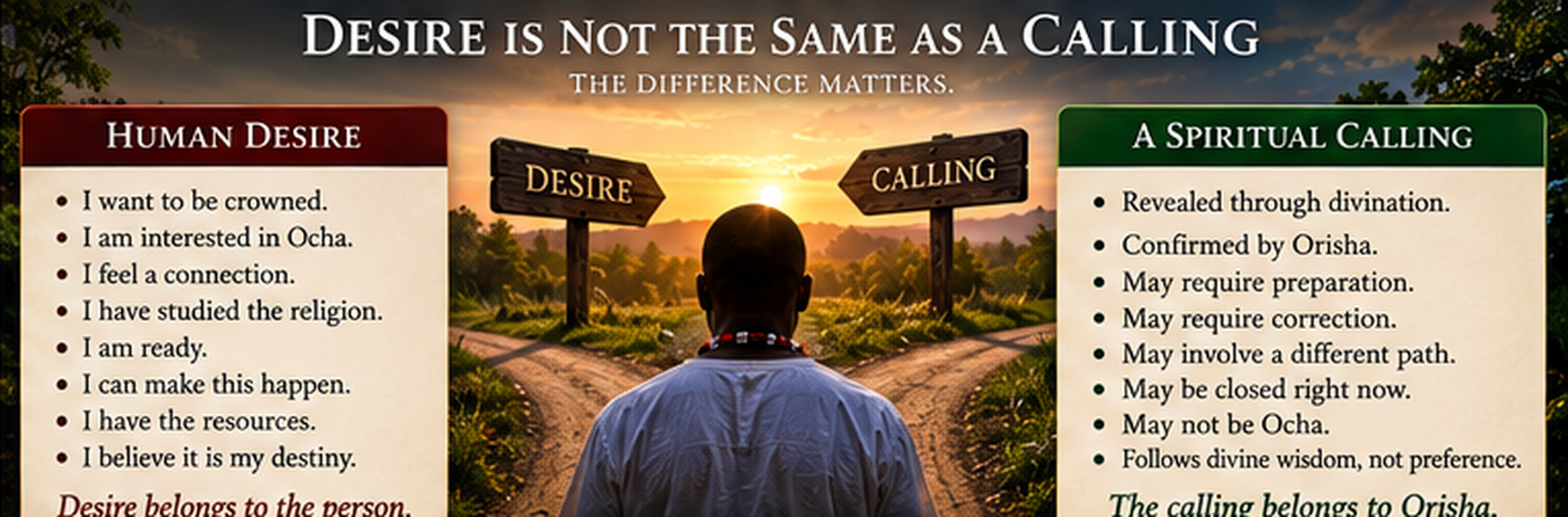
Yet wanting Ocha and being called to Ocha are two different things.
That distinction is fundamental.
In my understanding of the religion, Ocha is not for everyone.
People are chosen differently.
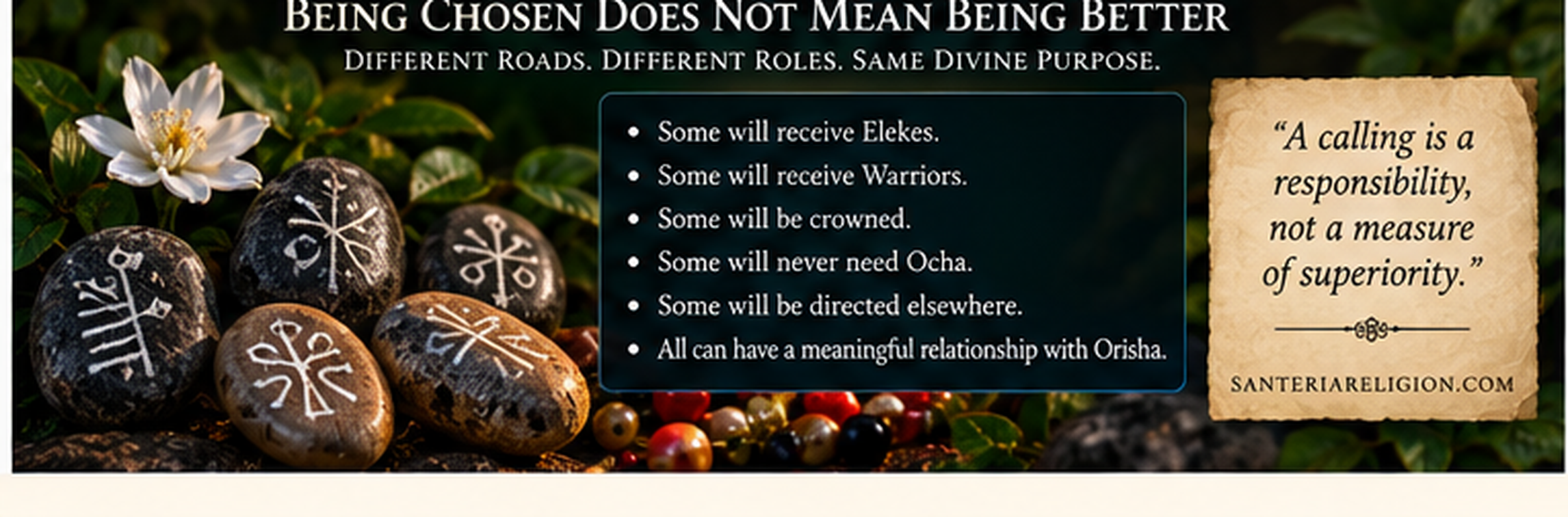
Some people will receive Elekes.
Some will receive Warriors.
Some will deepen their relationship with Orisha for years without ever needing to be crowned.
Some will eventually make Ocha.
Some may be directed somewhere else entirely.
The person does not determine the road simply because they want it.
Orisha does.
Desire Does Not Create a Calling
Human beings are accustomed to making choices.
We choose careers.
We choose relationships.
We choose where to live.
We choose what to study.
We choose what to buy.
Modern life trains us to believe that sufficient desire, money, effort, and access can eventually produce almost anything.
Sacred calling does not operate according to that logic.
A person may be fascinated by Ocha.
They may feel emotionally connected to an Orisha.
They may admire the religion.
They may have spent years reading about it.
They may even feel certain that initiation is their destiny.
That certainty still requires confirmation.
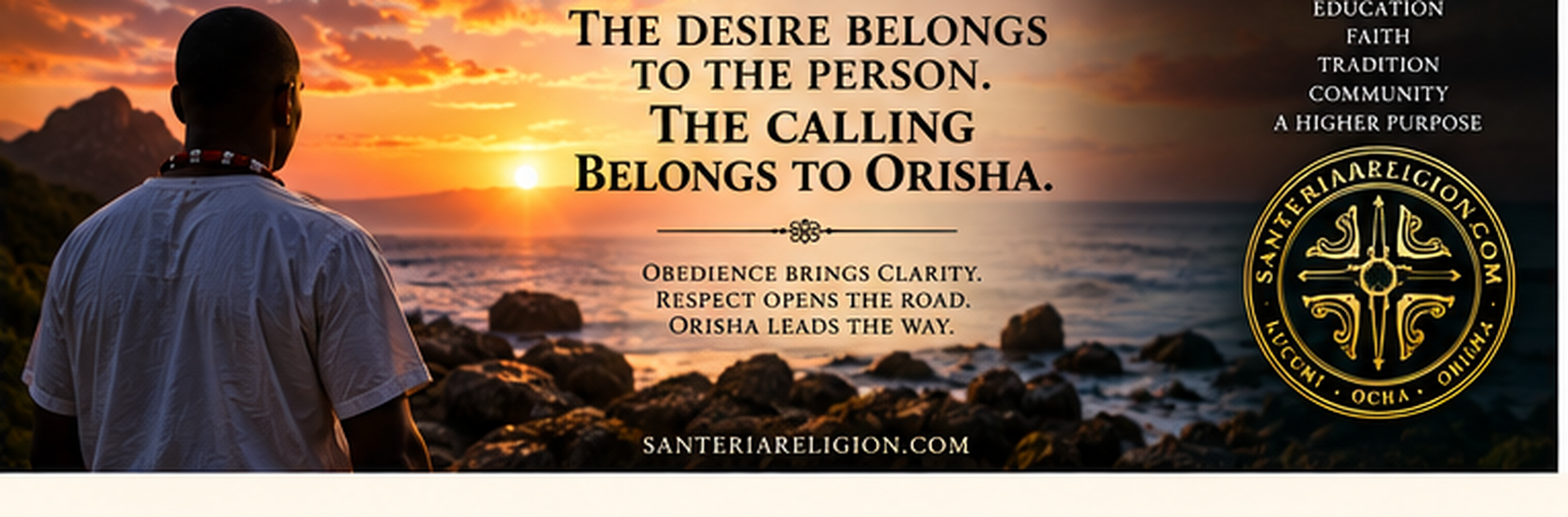
The desire belongs to the person.
The calling belongs to Orisha.
The Consultation Must Be Allowed to Say No
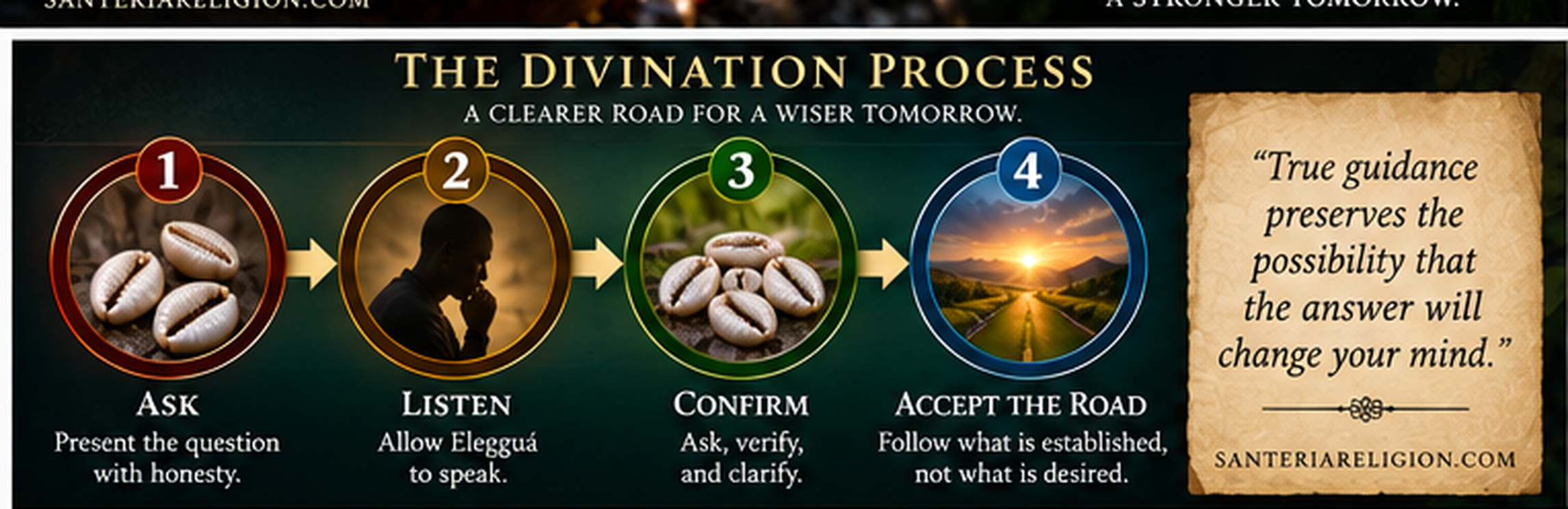
This is one of the reasons Diloggún must remain independent of the client's expectations.
A person may come specifically asking whether they should make Ocha.
The practitioner already knows what answer the person hopes to hear.
That creates pressure.
If the client wants initiation badly enough, even a cautious statement can be interpreted as confirmation.
The practitioner has to resist that pressure.
If Ocha is open, say so.
If it is not established, do not manufacture it.
If the consultation identifies another issue that must be addressed first, follow that issue.
If Elegguá closes the road, respect the closure.
A religious consultation loses its integrity when the answer becomes dependent on customer satisfaction.
The shells have to remain capable of disappointing us.
Elegguá Knows More Than the Question
Someone coming for divination usually brings a story.
The story may be accurate.
It may also be incomplete.
People naturally explain circumstances from their own perspective.
We know what happened to us.
We know what hurt us.
We know who we blame.
We know what we want.
What we often do not know is everything surrounding the situation.
Elegguá does.
That is one of the reasons I take the questioning process seriously.
A client may ask for help.
Before assuming what that help should look like, the consultation may reveal more about the person, the condition, the road, and the consequences involved.
The answer may become much more complicated than the original request.
Orisha Sees the Whole Person

This point deserves greater attention.
Human beings can conceal things from one another.
We can edit our stories.
We can minimize our own behavior.
We can describe a conflict in a way that makes us appear innocent.
We can blame someone else.
We can omit the thing we are most ashamed of.
We can perform goodness.
We can say the right words.
We can even convince ourselves of our own version of events.
Orisha sees beyond presentation.
They know the complete person.
The generosity.
The cruelty.
The loyalty.
The betrayal.
The suffering.
The harm done to others.
The promises kept.
The promises abandoned.
The things no one else knows.
That changes the meaning of spiritual help.
Suffering Does Not Automatically Make Someone Innocent
This can be uncomfortable to discuss.
Someone may genuinely be suffering.
Their pain can be real.
Their circumstances can be terrible.
They may also have contributed to the road that brought them there.
Both realities can exist at the same time.
Human beings often assume that suffering itself proves innocence.
It does not.
A person can experience consequences.
A person can damage other people and later become desperate when their own life collapses.
A person can ask Orisha to remove a condition while refusing to change the behavior that continually recreates it.
A consultation has to remain honest enough to reveal those possibilities.
Orisha is not fooled by the version of the story told at the beginning of the appointment.
Help Can Take the Form of Correction
We tend to imagine help as relief.
The problem disappears.
The money arrives.
The relationship returns.
The opportunity opens.
The illness passes.
The enemy leaves.
Sometimes help does look like that.
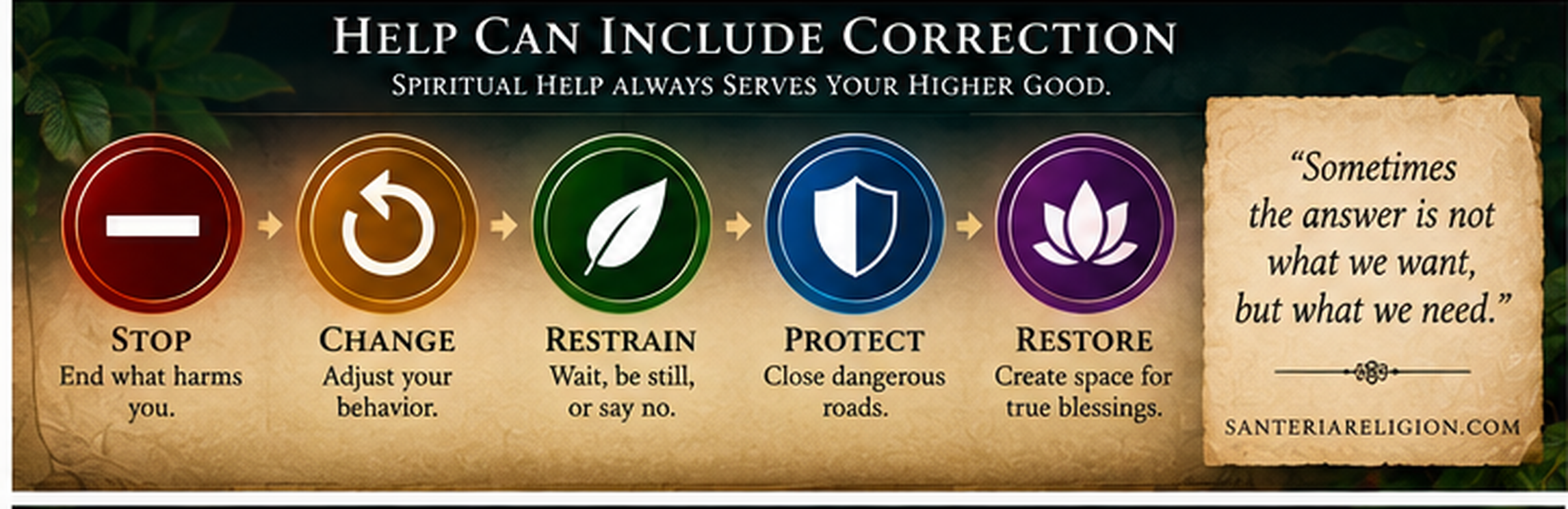
Other times, spiritual help may begin with correction.
Stop doing this.
Leave that situation.
Fulfill your obligation.
Change how you are treating people.
End a relationship cleanly.
Control your tongue.
Respect a boundary.
Accept the consequence.
Be patient.
Do the work.
Make the sacrifice.
A person may have asked for rescue and receive instruction.
That instruction can still be mercy.
Orisha Are Not Servants of Human Desire
One of the most dangerous misunderstandings of spiritual practice is the idea that religious work exists to make supernatural power obey human preference.
I do not understand Orisha that way.
We do not command them.
We do not bribe them.
We do not place an offering down and create a debt they must repay.
Orisha needs nothing from us.
The relationship is greater than transaction.
This is why a person cannot assume that because they performed an ebó, Orisha now owes them the outcome they originally wanted.
The ebó will produce what Elegguá said it would produce.
That distinction is crucial.
The practitioner must first understand what was actually promised.
Ebó Follows the Road Revealed
A client can easily reinterpret a prescribed work through their own desires.
Suppose someone asks about money.
The reading identifies a deeper condition.
Ebó is prescribed for that condition.
The person completes it.
They may then judge the work solely by whether a specific amount of money appeared.
That may never have been what Elegguá said the ebó would do.
The consultation must be followed accurately from beginning to end.
What condition was identified?
What was the source?
What was prescribed?
What outcome was marked?
That sequence matters.
Ebó is not a blank check.
It addresses the road established in the reading.
Sometimes the Answer Is Restraint
People naturally want movement.
Open the road.
Bring the opportunity.
Restore the relationship.
Increase the income.
Remove the obstacle.
There are times when restraint may be the protection.
Do not move yet.
Do not enter that relationship.
Do not accept that offer.
Do not pursue that person.
Do not force the ceremony.
Do not involve yourself in something you do not understand.
A closed road can protect a person from something they cannot yet see.
Humans often interpret closure as failure because we evaluate events from the immediate moment.
Orisha sees beyond that moment.
Ocha Carries Responsibility
People sometimes focus on the beauty of Ocha.
The ceremony.
The white clothing.
The Orisha.
The community.
The sacred objects.
The new religious identity.
Those things carry profound meaning.
They also carry responsibility.
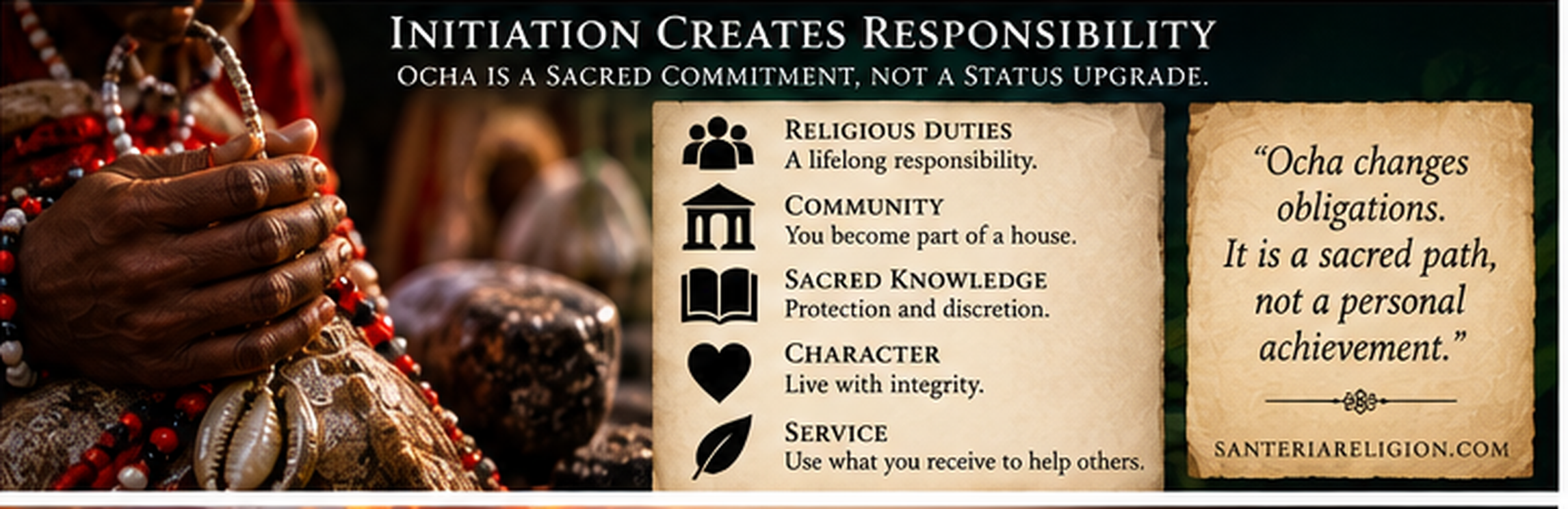
Ocha changes obligations.
It changes the relationship with Orisha.
It creates religious duties.
It places the individual within a lineage and a house.
It establishes responsibilities toward elders, godparents, godchildren, and sacred knowledge.
It can require discipline that extends across the rest of someone's life.
A calling this serious should never be treated like another achievement to collect.
Initiation Is Not a Status Upgrade
Modern culture encourages people to rank everything.
Beginner.
Intermediate.
Advanced.
Elite.
People can unconsciously bring that hierarchy into religion.
They may begin viewing Elekes as one level, Warriors as another, and Ocha as the highest membership tier.
That framework distorts the meaning.
Different people require different things.
Receiving more ceremonies does not automatically make someone spiritually superior.
Having received many Orisha does not excuse poor character.
A title does not create wisdom.
Consecration creates responsibility.
How a person lives with what they have received matters more than how impressive the list sounds.
Some People May Never Need Ocha
This is worth saying plainly.
A person can have a meaningful relationship with Orisha without eventually becoming crowned.
That does not make their path deficient.
The religious life appropriate for one person may be completely different from the life appropriate for another.
A person may receive what they need and remain there.
Their road may be complete at that level.
The idea that everyone must continually move toward more ceremonies can create unnecessary pressure and, in the wrong hands, financial exploitation.
Orisha decides what is necessary.
The practitioner's responsibility is to respect that determination.
A Practitioner Should Never Recruit Everyone Into Ocha
There is an ethical problem when religious guidance becomes recruitment.
Every client suddenly needs another ceremony.
Every difficulty becomes evidence that initiation is necessary.
Every consultation somehow leads toward a larger financial commitment.
That pattern should concern people.
A practitioner should be capable of telling someone:
You do not need this.
This is not marked.
Wait.
Do the work already prescribed.
You are trying to move too quickly.
Follow the road you actually have.
Religious integrity sometimes means refusing money.
Fundashe Requires Restraint Here Too
This is another place where Fundashe and character become inseparable.
A practitioner may have enough religious knowledge to convince a vulnerable person of almost anything.
That creates tremendous moral danger.
Someone facing illness, loss, fear, or financial collapse may be highly suggestible.
They want hope.
They want certainty.
They want someone to tell them what will make everything better.
The practitioner must protect that vulnerability rather than exploit it.
Fundashe should increase restraint.
The more spiritual understanding someone carries, the more carefully they should use it.
Orisha Knows the Practitioner's Motives Too
The client is not the only person being seen.
Orisha knows the practitioner.
If I tell someone they need something because I want their money, Orisha knows.
If I exaggerate danger to create dependence, Orisha knows.
If I manipulate someone's fear, Orisha knows.
If I claim authority I have not earned, Orisha knows.
If I change a reading because the truthful answer might upset the client, Orisha knows.
If I protect the message even when doing so costs me financially, Orisha knows that too.
Nothing is hidden on either side of the mat.
Accountability Is Part of Sacred Life
Religion should never become an escape from responsibility.
Someone who harms people cannot assume spiritual practice will erase consequences without transformation.
Someone who repeatedly creates chaos cannot demand that Orisha continually clean up behind them while they refuse to change.
Someone who lies to everyone around them cannot expect deception to remain invisible at the mat.
Sometimes the most important spiritual intervention is accountability.
That may feel harsh when someone arrives seeking comfort.
It can still become the beginning of restoration.
Being Chosen Does Not Mean Being Better
There is another danger.
If someone is called to Ocha, they may begin believing the calling proves spiritual superiority.
It does not.
Being chosen for a responsibility means you have been given a responsibility.
It can mean your life requires that road.
It can mean Orisha has work for you.
It can mean you need the transformation the ceremony brings.
The calling does not necessarily say that you are more worthy than the person beside you.
Sometimes the person given the heavier responsibility is the person who needs greater correction.
Humility matters.
Orisha Often Meet People in Broken Places
Some of the most powerful stories in Ocha begin when someone's life has fallen apart.
Illness.
Loss.
Abuse.
Betrayal.
Poverty.
Isolation.
Fear.
Grief.
People sometimes arrive after conventional solutions have failed.
They may feel abandoned by life.
And Orisha lifts them.
That is one of the things I find most beautiful about the tradition.
The sacred does not belong only to people who already appear successful.
Orisha can meet people in the places where human beings have lost hope.
There is extraordinary mercy in that.
Mercy Still Has Wisdom
Mercy does not require indulgence.
Helping someone does not require approving everything they have done.
Love can include correction.
Protection can include closure.
Rescue can include a demand for change.
The person who is lifted may still be required to become different.
That transformation can be part of the blessing.
I sometimes think this is one of the deepest misunderstandings people have about divine help.
They imagine love as permission.
Sometimes love is instruction.
Orisha Are True Saints
I have said before that Orisha often lifts people who have been damaged by life.
People who have nowhere else to turn.
People who have been discarded.
People who have suffered.
People who arrive carrying circumstances that seem impossible.
This is part of why I think of them as true Saints.
They enter human suffering.
They correct.
They protect.
They restore.
They open roads.
They close dangerous ones.
They demand what needs to be surrendered.
They ask people to become better than they were when they arrived.
And sometimes they save people.
That kind of sacred relationship deserves more respect than reducing Orisha to wish fulfillment.
The Road Is Personal
No two lives are identical.
No two consultations are identical.
No two relationships with Orisha are identical.
Even people within the same house can have dramatically different roads.
One may be called quickly.
Another may wait for years.
One may need Ocha.
Another may never need it.
One person receives a blessing through expansion.
Another receives protection through restraint.
One is told to move.
Another is told to remain still.
The road is personal because the person is known personally.
Ask for Guidance, Then Accept Guidance
There is a paradox in divination.
People often say they want guidance.
What they sometimes mean is that they want confirmation.
Those are different experiences.
True guidance preserves the possibility that the answer will change your mind.
It may challenge your assumptions.
It may reveal something you did not know.
It may ask more of you than you expected.
It may close the road you wanted.
It may open one you never considered.
If we only accept answers that agree with our desires, then we are not really asking.
We are negotiating.
Elegguá deserves better than that.
The Practitioner Must Protect the Answer
This creates a final responsibility for the person reading the shells.
Do not manufacture favorable answers.
Do not recruit everyone into Ocha.
Do not promise that every ebó will produce whatever the client wants.
Do not identify enemies merely because the client wants someone to blame.
Do not soften a message until its meaning disappears.
Do not transform spiritual authority into salesmanship.
Communicate what Elegguá gives as faithfully as possible.
That is the obligation.
Ocha Is a Calling
Ocha is sacred because it cannot be reduced to consumer choice.
The person may desire it.
The community may encourage it.
The practitioner may have an opinion.
Ultimately, Orisha determines the road.
Some people will be called.
Some will wait.
Some will receive different things.
Some may be corrected before they are given what they seek.
Some may discover that what they wanted was never what they needed.
And some may be lifted from places they thought they would never escape.
The purpose of the consultation is not to make the client happy for an hour.
It is to reveal the road.
The purpose of the practitioner is not to control that road.
It is to listen.
And when Elegguá speaks, our responsibility is to have enough humility to accept that the answer belongs to him.
Maferefun Elegguá. Maferefun Orisha.
About the Author
Keith Lawrence Miller, M.A. (Ogun Oní) is the founder of SanteriaReligion.com, an independent educational platform devoted to Santería, Regla de Ocha, Lucumí religious literacy, Diloggún, Orisha tradition, religious history, spiritual development, and the preservation of sacred boundaries.
His work draws upon lived religious experience, sustained study, practitioner knowledge, public theology, and respect for the authority of elders, godparents, lineages, and individual houses.